Podcast episode
Ep30 | What is my way out? (Ft Julius & Divine)
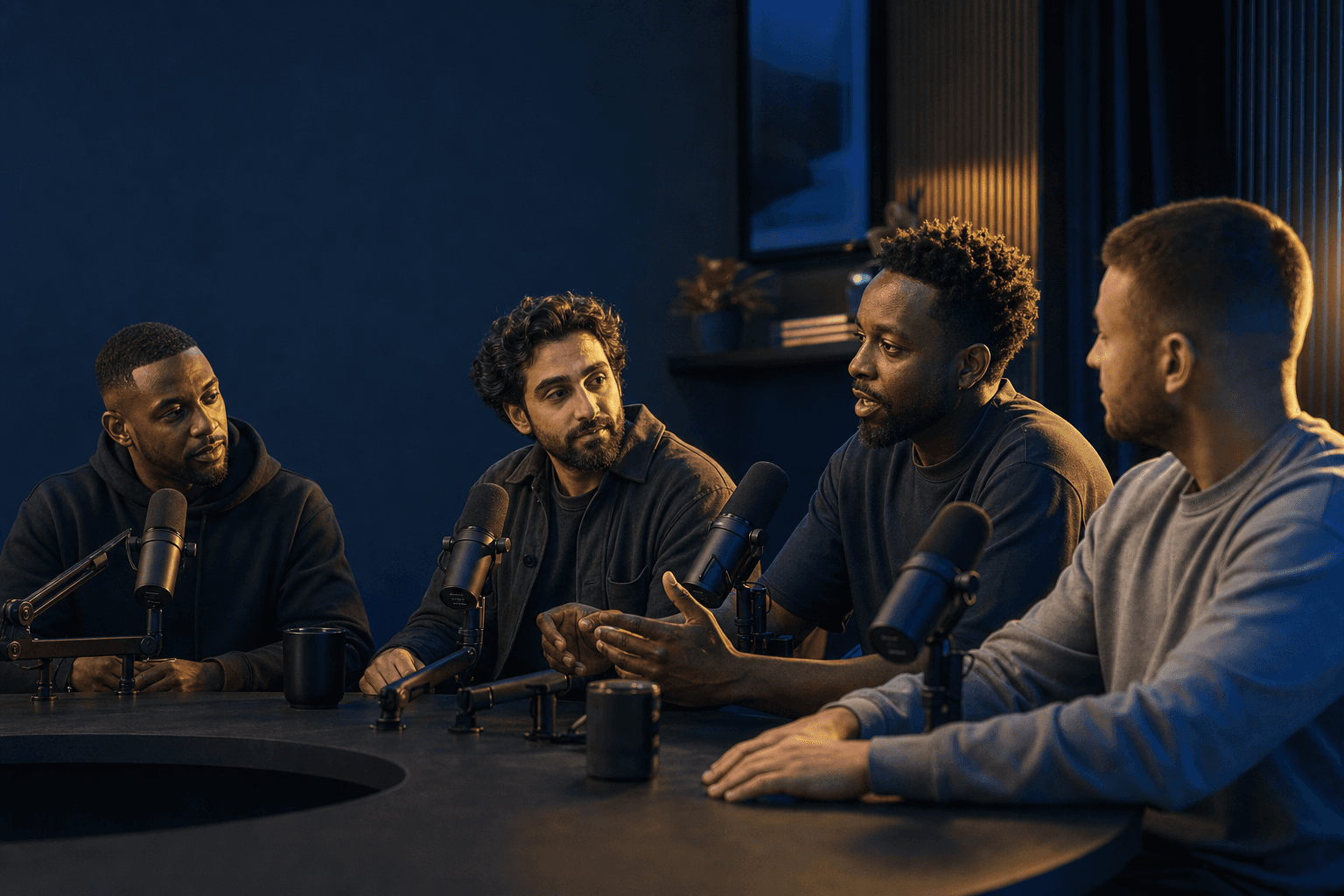
Julius and Divine with the hosts on ways out: sport, coaching, leadership, and what success is allowed to look like.
94 min
In this conversation
This guide follows the published episode notes, which describe upbringing, education, parental expectation and paths that are not only the obvious escape. The full transcript is available below.
What the episode notes say
- The notes centre on how people picture success, and the routes they consider when they want a way out.
- They mention the move from athlete to coach, and leadership, especially in a Black community.
- They mention upbringing, education and parental expectation, including the pull of other paths.
Questions to sit with after you listen
- What have you been calling the only way out?
- Whose definition of success are you still trying to satisfy?
Related
- Am I willing to die to get rich?
A nearby conversation about what the race is actually for.
- Are you a false leader?
Role models and pressure, from another episode.
Transcript
Automatically generated transcript, with paragraph breaks and topic headings added for reading. It may contain transcription errors. Speaker labels are included where supplied by the source; listen to the recording for tone and context.
Introduction and guests
speaker-0: to make sure there's an awareness that it's not your only way out. It's a lesson in life. Don't discount that as a s an option that you have. Some people it's options. They can do whichever suits them or they prefer whichever route they prefer to go. For some people they don't have options, or those are the only options. speaker-1: This, this is talking to my friends. Yes, yes, everybody.
Welcome to Talking to My Thoughts, the podcast where we have open, honest, and raw conversations with a twist. We bring a unique perspective on our thoughts by literally pre-recording the things that are on our mind before talking about them with the group. And we do this because we believe before you can be open with others, you first have to be open with yourself.
So stay up to date with all of our content by following us on our socials at Talking To My Thoughts. I make sure you guys listen to the end to hear our responses to some of your thought-provoking questions. Now, my name's Simon, aka S J. I am a proud Saint Lucian, obviously a Caribbean black man. I'm a father of two beautiful girls and I'm a content creator. Craig. speaker-3: My name is Craig, aka Mr.
Positive, a cheesy motivator with a St. Lucian background, big dreams, and a passion for helping others find and maintain their peace. speaker-1: Wicked man. And we're obviously thankful today as always to be joined by our two special guests today. Julius, you want to go first and introduce yourself, please. speaker-0: Cool, good evening. I'm Judas. I'm I'm a father, I'm a business owner. I own the Rainbow Bakery.
I'm an entrepreneur, mentor and consultant, a proud father of three. so yeah, I'm also known as Mr. Rainbow. speaker-1: Nice one. Thank you so much. And Divine, please introduce yourself. speaker-2: Yeah, good evening guys. Yeah. I'm a proud Varnian. Obviously born here though. I'm a researcher for the council. proud football coach, you know, first and foremost. Yeah. And a FinTech hopefully one day a FinTech mogul.
speaker-1: Amazing, man. Nice. All right. So before we jump into our main conversation and talk about the topic at hand, we obviously want to give our listeners a little bit of an opportunity to know our guests a little bit better by starting on the front foot with a couple of questions. So I'm gonna just pose two questions to you.
and the first question is, and this is to both you guys, so maybe Julius, you can kick off first. If your life expectancy was 500 years, how would that change your life? What would you do differently? speaker-0: I think it's I probably would take more chances knowing that I've got more time that if it didn't go the way wanted to, I could sort things out.
yeah, I think I'd I'd I I think I'd go through I'd possibly go through it more. I'll try and do more things. but also be more prepared. The fact that whatever I'm in, remember that it's Bob and Diaz I'm gonna be I'm gonna be alive. I experienced it. So yeah, that's what I think. I I think that's what I would I would do. If I knew it was five hundred years. speaker-1: Amazing. Divine, what's your thoughts?
speaker-2: Yeah, that's that's a that's way too much latch, right? speaker-3: Yeah. speaker-2: A hundred years five times. That's twelve a hundred years for me, I obviously I'll look at all the the loopholes, the fixes in life. But the those next ne you know, a hundred years I'll I'll definitely teach y you know, generations, you know, to do better. So we can have like better democracies.
Because like honestly, like the twentieth cent or twenty first century now, I mean th things have changed but things haven't changed, you know, from like the last century. So I would like try to be like a leader, you know? That that try that try to change the course of time. speaker-1: Nice. Alright, cool. Alright, one more question. One more question.
So, If you could get away, and be careful here, if you could get away with any crime in the world, what would it be? speaker-2: Mm. it's it's funny because I look at this as another paradox. It's like we as a community, we have like sanctions like on us, like especially in America, like you know, like the the redlining the housing.
And if if I can allocate all resources for a fair thing, you know, technically that'll be a crime in in in in the context of the rulers who are who who made those sanctions. When when you think about it, so allocating resources, making it fair for everybody. speaker-1: Mm. Yeah. amazing. Craig, I know you want to say something about that. Go on. What's your thoughts on that one? speaker-2: You know what?
speaker-3: To be honest with you, I was just thinking about COVID and the restrictions. So I'll just be skipping borders and stuff, making sure I don't care if I COVID, no COVID, whatever, I'll just be skipping borders because I was missing home. So I'm thinking about, hey, speaker-1: Yeah yeah. speaker-3: did you do did you do did you do your your jab? Yeah, yeah, jab dog. I'm jabbed.
I'm jab and I'll just and then I'll just be going about my business. Even though I could have technically done that already, or maybe I'll you know. That's my thing is. Just going back home as much as I liked, during the whole Covid thing, no matter what the restrictions were, that was speaker-1: Yeah, I hear that.
for me, like I'd have no problem breaking a law off if I think it's it's fair and it's just and like Because if you think about it, how many odd years ago when slavery was around, it was against the law for a black person to go into a like a white person's house or for a black person to marry a white person. Like all of those are crimes. It depends on what it is.
But for me, it's like the ones that I think are just a bit stupid. Like I'll happily break them. I ain't got no problem with that. speaker-0: Without I could add if I could add, speaker-1: Go on, go on. speaker-0: my my my dad's old school, so what I didn't say is I'm I'm a proud Lucian as well. Proud Lucian, I'm a married man.
And the reason why I say the the Lucian part is my dad's Lucian and there's an old school way, I think it just didn't make a cause of Lucian, old school way of thinking, 'cause he came over in the sixties, he had that problem of of racism. But also being a married man with a fam a married family man, question that I've got for many people is could you could you kill a man?
Now my dad is very simply like he's old school and he's been in positions where he just he didn't he won't he wouldn't think twice. It's like himself. Simon, he's just thinking, you know what, is as long as I'm five in my head, you know what, putting me in prison is not gonna it's not gonna make me feel bad about myself. Because in my head, I've got my principles and that's just fine. I know what I had to go and do.
Me as a family man, and I say to other people, some people say, No, I couldn't I couldn't kill a person, I don't know if I could do it. But depending on the the circumstances. So as a family man, I might not even know it, but if you did something to my family, I could just end up with blood on my hands. I didn't know how it got there.
But what it was is that you did something to not just you did something to my child or my wife. And one of the strong themes I've got at moment is that every child is my child. Since I became a father, I can't watch a man do something to another child and stay out of it. So that breaking the law And committing a crime, sometimes we don't even know that we would do it.
You just have to be what's the what I'm looking for? not incited. Yeah, you just it just has to be presented to you and you just find yourself doing it. You just break that. And like you said, Simon, in your head you're thinking I don't you can you can put me in prison, but I'm not gonna feel bad about it because I know why I don't speaker-2: Yeah, exactly.
speaker-3: This is a perfect segue to the next speaker-1: Man, all right, so let's let's not get too deep into that. So let's segue to the topic now. And actually, the topic for today is an athlete, an entertainer, or a criminal, is that my only way out? And when we say way out, essentially what we're talking about is almost becoming successful enough to move out of the quote-unquote hood.
So I guess it in as few words as possible, just to kind of kick off that conversation, in as few words as possible. What does that mean to you when you first hear that topic? What does that mean to you? Why?
speaker-2: Yeah, I was I was gonna say w which one the the entertainer athlete or or speaker-1: So when you hear that topic, so when you're thinking about is this my only way out, what d does it trigger a a particular thing in your mind? What's the first thing that kind of go goes through your head when you hear that? speaker-2: First thing that goes is is you've been hand handed a set of like handed a set of cards.
What counts as a way out?
I think I think if you're in the hood and you listen to the media, that's what they'll project on us. You know, like there's there's definitely more than just those three topics. There's obviously, you know, being being intellect, you know, being a leader as well, being a teacher. But yeah, that's that's pretty much the that's what's been said to us if we're in the hood, you know. speaker-1: Yeah. speaker-2: Cool.
speaker-1: Craig, Craig, what's your thoughts? speaker-3: I try to know it make it seem it's just a hood 'cause I know there's loads of different types of cultures as well. So I would say being put in a circumstance trying to get out of your circumstances, basically. Need it be financially or actually in a situation, a country or an area that just doesn't work for you.
And I think you're you're gonna find any way to get out of it in the belief that once you're out, your life is set. The whole problem was the circumstance and nothing else. speaker-1: Yeah. speaker-2: Julius. speaker-0: the first thing is comes to mind is a bit of sadness really because I think many people they feel that's that that is the way it is.
Maybe because of the environment they've been brought up in, whether it's because of the people around you know, the the the the the parents how they've been parented or or social group they're in. So I just feel kind of sadness and from my experience it's like it's just there is no awareness that Many people don't people don't have the awareness of their their whole value.
Just because you're good at football in school, you know, you've been encouraged to do that. And because you haven't all the awareness and the support, you think that's the only way. And yeah, you you you don't see much hope.
So it's a quite sad thing, and I just think there's a there's an important it's very important there are people out there who can show, you know, there's many ways that you can become successful. speaker-1: Yeah. Yeah. I agree with all of those points actually. I think for me when I first when we first was putting this topic together, for me it was like almost a sense of feeling like trapped.
'Cause like when the topic says, Is this my only way out? Like immediately I feel like as a people, as a as a community, we we almost feel trapped and we have to we have to break out of that entrapment, so to speak. So yeah. Let's speaker-3: Yeah, okay less than speaker-1: let's open up that conversation a little bit more then. What I'm gonna do, I'm gonna play the first voice recording.
let's pay attention to it, have a nice listen to it, and then we'll just reconvene and open up the conversation from there. speaker-2: Yeah. Yeah, the topic on being an athlete is very important in our community. I'm an athlete myself. of many kinds. I used to be one in the context of football. I'm currently one in terms of yoga. but let's go to the football bit first.
With that one Now I'm in a situation where I find myself in life as a coach. And it's it's a real privilege, you know, in terms of coaching kids, young players, making them into athletes, you know. Seeing them in their stage of life developing into not just athletes that society wasn't to see but athletes that they can be proud of themselves. You know. Athletes where they are elite for our community.
with that with that I feel feel as an athlete You have to pretty much pass on what you know. in terms of your generation. There's different generations. There's obviously blueprints in terms of what needs to be produced. And through that philosoph philosoph philosophy philosophies are developed that can improve the next generation.
But yeah, all that aside, as a coach But I find joy in coaching coaching coaching the youth from younger ages you know, from sevens to basically mid teens, sixteens, just to see, just to see. The young youth develop. You know, 'cause it's important. It it'll give them a sense of being at that stage in their life. It'll give them a foundation to improve in life as well.
Also, from that, the most important thing I believe in through that is being a leader. Because being a leader is key. Because on the field, whatever sport you're doing, it will show. And then once you get that criteria, you can take it off the field, and this is where the character builds. And as a leader, from being an athlete, you have built character in life. For example, The coaching I do with Harangay.
We pretty much take youngsters off the streets, you know, off the street life, you know, the places they don't have no business being in. You know, we take them to our to our training facility and we we we train them into athletes. And that's the ROI, you know. They come out as leaders, you know, they have they have great character and that's the that's the benefits of of being a coach. You know, developing athletes.
That's my thoughts on on developing athletes. You know, when you're on the field, when you're in training, you know, you learn drills and techniques so you can be accountable in those moments. And then you take it into life situations. In fact you you you grow men, you develop men.
And it goes to that saying, you know, when men ask, you know, when When they say they say this separates the boys from the men, it's true. It's true. You know, with visions and philosophies in terms of creating athletes. Yeah, those criteria and training will separate men from the boys. So it's important to to develop young athletes. And you know, they'll be a great asset to society. Society. Parts of society.
You speaker-3: Yeah. speaker-2: know, in terms of our community. And also another thought as well. Like I have a strong strong str you know look in terms of how I don't think our athletes should be subjugated towards because of our because of well obviously we're black. We shouldn't subjuge be subjugated towards you know us being like a a porn in entertainment. You know, like we shouldn't be seen as entertainment.
Like we're more than just athletes, you know. We're We're political people, we're people who change societies. Look at LeBron James with the basketball. You know, look at Colin Kapanick. So stuff like that. You know. That's the side people don't see in terms of raising athletes. Even with the football as well, you know. I encourage athletes of of African Caribbean to play for your original native nations.
You know, you ain't gonna get all that fuss in terms of the Black Lives Matter because We know our native origin, we know our native blueprint. So I encourage the youngsters to represent their native nations. And that's another aspect of athletes and political politics. But yeah, as a wrap up. Being a leader is important in terms of bringing up athletes. speaker-1: Amazing, bro.
Sport, leadership and identity
Thank you so much for sharing that, man. there was one thing actually, actually, there were two things actually which stood out for me within that that thought process. what you shared with us. So one thing you mentioned which stood out for me was first of all about leadership. That was something that stood out for me about leadership. So I want to kind of open up the conversation about that for a second.
And then also I think the second thing was about when you mentioned towards the end, especially because obviously you you more so focused on Like the athletes, and obviously for obviously from your background, that would that would make sense. That people shouldn't necessarily as an athlete be looked as looked at as solely that. And there's obviously a lot more to a person than what they do, essentially.
so I just want to open up that conversation a little bit about leadership. Divine, explain to me a little bit about why you think that's important and how that how that can kind of translate outside of the world of just being an ac athlete or being an entertainer or even obviously as we haven't yet touched on being a criminal. Why is that leadership for you important? Why did you touch on that?
speaker-2: Yeah, the leadership is key because when when you're out there on the field, everybody's watching, regardless, you know, whoever you are. And you you have to carry a sense of accountability, you know, in terms of where you're from. So you you you can actually leave a blueprint, you know, you can actually pass on to generations. And like for example, where do you finish your football game at a big level?
They always look at your You know, your you know match rating, did he get a five out of ten? Did he get, you know, a seven out of ten? Don't believe in that. That's that's society makeup. I feel did you do well for yourself, did you do well for for your nation, did you do well in terms of what you trained in? That that's being a leader. Like athletes, like for example, some some of them will fall off the rails.
That's not leadership. An athlete with a decent career that's doing well, you know, for his nation, that's a good leader. speaker-1: Okay. Craig, what's your thoughts? Did you pick up from that? speaker-3: It was quite i it was speaker-2: Yes. speaker-3: pretty interesting because and I have a question which kind of sides with you and then a controversial one afterwards.
So you definitely used you you you saw athletes as a completely different s you didn't see athletes as athletes. You wouldn't even really you were just saying that it was you believe that athletes were it the using athleticism or being in athletics or even being a a a person who is a footballer, whichever one it is.
Around sports used as the avenue as to how they would build themselves as a person in the end, how they would end up becoming a leader, becoming a a a character, a great character, growing a great character, and becoming a person who is needed in society, funny enough. and I wanted to kind of find out why did you why why did you feel that that that that way about it? why do you feel that that is key?
What do what is it that you believe people gain during that that journey? on in sports and then afterwards I wanted to know before you became a coach, did you always think that way? Was there ever a case that you just saw that athletics was out like going into being a footballer was just about the money or we it was nothing to do with serving the society? speaker-2: Yeah, that's the thing. you're right about that.
I I I looked to it that way. When when you're doing when you're actually being an athlete, you you do focus on the physical side.
But per from personal experience, when you get injured, that's when even though we're we're dealing with you know, the the med the the medical scenarios that they put to athletes, when you do get injured, that's when you realise, you know, that that that's the only value I had my physical ability. This is why I I teach it's all about the mental as well.
Because honestly from the experience, I've actually dealt with players that fell into depression, you know. W once they had, you know, life threatening injuries and they had nothing to to live for other than just their physical ability. So that's why I say, you know, it's always the mental aspect you have to give beyond your sport. You could be an athlete in the mind too. speaker-3: Understand.
And be and before you became a coach, where where was you where was you with your like did you ever just I guess did you face the injury yourself as to why you suddenly saw things a bit different? speaker-0: Yeah speaker-2: I'm thirty now. I should be still playing. I've I've had a decent playing career. I I played semi pro. I could have played pro, but like going back to that speaker-1: Everybody says that.
speaker-0: That's good enough. speaker-2: Yeah, going to that crime thing. I wish that the world was borderless because obviously papers affected me, so but yeah pla playing career like you're you're really in it and you're really e everything is physical, you know?
But when you go into a coaching you re a coaching role, you really get a a pr a perspective of of I have to pass this on, you know, and and and you can't play all the time. And I and I being in that predicament, like I actually enjoy coaching more. it's it's it's way better. It's it's starting off is actually better than playing.
I know that sounds like wrong, but it it's true, like you can actually see the game from a different level and make tweaks. Yeah, see yourself in a few players. So yeah, and it's it's it's just a natural transition. I mean, you're seeing it now with a lot of pla well, coaches like Lampard, great player, now coach, even herber as well, there's a guy called Sean Malone, he's he's a coach too.
And he he was a decent player in the Premier League. So, you know, just that transition, Zinadine Zidane, you know, in Zagio of Inter Malan. So it it is possible. It is possible, you know. speaker-3: That's that's interesting. I think that I guess there's there must be a gem in stepping outside of yourself and kind of watching from the outside and then kind of helping people w transition through.
Well d no, that's that's that's thanks for the the the feedback on that. I guess Julius, what's what's your thoughts on or you speaker-0: It's interesting what Divine said because it kind of changed my perspective about approaching this topic. Is it my only way out? And what I've started to think from Divine points that Divine was making is this young from the young age that you know youngsters should be made aware.
It's not the only way, but you definitely should consider it as an option. You know, it's an option of development. You know, and I think it is because some some some people Those are only those are the only options they actually do have.
They don't have that kind of they don't have that mental, that kind of role model accessible accessible to those people to be able to to know about the other ways, but it's to not be discounted as well. They actually that's one thing the most powerful thing about Web Changware perspective is they are possibly very three very powerful ways to build yourself.
I wouldn't tell someone to go and become a criminal, but it's not that, you know, how many times have we thought of you know, people in criminal business activities think of them and think, you know what, you're wasting yourself because you're using the same principle that I would use in business, but you're applying a way which is against the law.
If you only had the opportunity to go that direction, when it comes to what divine said about athletes, is I was an athlete of type, not as far as the violence as a youngster, that was one of the options I had. I have many options to help build myself. Basic.
If you're only it starts at a very early age to start to build your character and your attributes, you know, but you can only, as they say in football, you can only eat one. It's not so much that's the best way to describe it, but the bottom line is that it's you one of the first opportunities you've got to display your natural ability, and it's and this they are opportunities to develop your ability.
So the leadership, the idea of leadership, which I I agree with Divine, because I've been told that I'm a natural leader. Playing football. I only played football up until the age of well, I play I still play football now, but seriously while I really was showing my potential was probably into just until the end of secondary school.
And that's where people it's one of the ways at that age people could see that I was a natural leader. So it's it's not the only way, but it's one of the ways. And it's not to be discounted how you can use that opportunity to display attributes that you need in later life to be that success. So one of the other things for me is I don't go to the gym, could probably quite tear I don't go to the gym.
But speaker-1: Okay. speaker-0: one of the reasons is I just can't see the sense in just it doesn't work in my head to pay money to go from paying. However, football is the only things where I have the mentality like people who go to the gym whereby I would push I will keep on pushing because I'm passionate about it. I don't want I used to play defensive midfielder. Okay. And I didn't let anybody get by me.
And I took it personally to dead. It's a vendetta I've got right now for you. So that taught me to be resilient. That taught me to to to to have no fear. And all the kind of things that in later life as I've experienced you need to be to to get to the top of your your your profession, your your your you know, whatever your your vocation, though those attributes. You need those and I developed them.
Part why started was was was there. So so yeah, from what Divine said there, it just made me think to myself is there's another way to look at this kind of topic is to make sure there's an awareness that it's not your only way out, but it's a lesson in life. Don't discount that as a s an option that you have. Some people it's options, they can do whichever suits them or they prefer whichever route they prefer to go.
For some people that don't have options, those or those are the only options. Yeah. And I think crime haven't really addressed is some people is that they that was the only option. They never intended to stick with it. It's the only way they know they knew how to develop themselves to be able to succeed in life later life. speaker-1: Well is that is that something? Go on, Divine, go on, go on.
speaker-2: Yeah, I wanna add to that. Yeah, it you're you're right. Like it it does a way out, like you could have an athlete who's not naturally talented and he could actually take those leadership levels and actually become an amazing businessman. And I and I've seen so many stories like that. so it does a way out. That's that's that's key, that that that that knack for being a a good leader.
speaker-1: Yeah, I was gonna I was gonna ask. Thank you for sharing that guys. I was gonna ask, so obviously, funny enough, well, interestingly enough, I guess, Julius and Devine, you've both, I guess, from a younger age, gone down the athlete route. We're looking at those kind of three different ways out, which is athlete, entertainer, criminal. Is that something that you considered when you was younger?
Is this is really the only way I can make it, or this is just what's been shown to me as a black man that. For me to be successful, I need to be a footballer or I need to be a rapper or I need to sell drugs. Like is that was that something that was already ingrained in you, which is why you went down that route?
Or what do you are do you know what your thought process was when you was younger to why you decided to go into that athlete direction? speaker-2: Yeah, like obviously grade school here in Acne, like I was involved in a lot of a lot of circles and there was a lot of competition and and the funny thing is that that that was sold to us in those, you know, teenage years, in those young twenties.
But as I got older I realized you can be in that, you know, circle, but what's your end go? What's your end game? You know, like I my personally I like obviously. I don't want to say this, but when I was young, I I supported England. You know what I mean? As as as I got older, I realized, you know what? I'll rather do everything for Ghana.
Like when I found out about the Ghana national team, shockingly in in 2006, I should have found out earlier. I was like, yeah, you know, being an athlete, I'll rather do it for Ghana. And that and that was the motivational vibe for you know my home country. You know, and I'm sure you guys were gonna say for for for say Lucia, Africans as well for Nigeria. Because when you get that.
That motivation, everything is clear. I'm doing this not for England, or I would do it for my home nation. And that's where you find peace, that's where you find gratitude, you know, all the positive things. speaker-3: To touch on on the like who you you speaker-2: Yeah. speaker-3: do it for.
Yeah so there's two parts actually which I wanted to highlight, especially for the listeners, is the fact that it it seems like it's not the fact that athletes, entertainers or criminals are not required. That's objective in itself, but it's not the fact that that's that they're not required, it's the fact that maybe there are necess there's a necessity for people like Divine to coach people through through it.
So a lot of people can get stuck in their head about what they're doing and only focus on the men the physical, because obviously that's what they're getting judged on. But they are there is a need for people outside, as as Divine said, a leader or leadership or coaches basically to help bring the person back to remember why you're doing this in the first place.
Kind of like our our parents when they tell us why do we go to school. Some of them just said to go to a school and don't really do and don't like don't say nothing else. But some of them actually really try to say, you're doing this because you're developing yourself. you're trying to reach somewhere. You're gonna do something with your life, et cetera.
so that's one of the things I realised with with Divine is there's this pro from there's a necessity for coaches and people to remind them.
The second part about was you mentioned and again speaker-2: A lot of speaker-3: A lot of people who have done really powerful things in the world and successful things were celebrities, entertainers, whatever it is, has often impressed us because they have chosen to focus on something beyond themselves.
And what you just mentioned was the fact that you focus you will where you gain a bigger focus was when you started to do it for your nation, your country. Thankfully I'm not in sports, so I I don't have to feel biased if I say I don't I don't care about I don't care about I don't support anybody. But one of the things I did support was the Olympics. And when you see like people at Jamaica, St.
Lucia, and all the other Caribbean countries and African countries start to like succeed, Mofar, all of that, it was like, yo, that's speaker-1: Yeah. speaker-3: and they were the top of the field and you know that they're untouched.
And you feel of a a feel about so as an athlete, probably, if you're doing it for that reason, again, to do it beyond yourself, to do it for your country, then brings you into this lead it brings you into this leadership, this political side, this so societal like you you're doing something for your society and then now you for you don't just focus on I'm gonna be really great on physical and then I'm gonna get paid bare money and then I'm out.
You're now focusing on something bigger, which again, if we know what how people are kind of grown and some of the people that impress us are role models for ourselves, we know that they've probably done things that are beyond just what their field was. For example, for me, like one of my role models or the people that I actually aspire to is like Will Smith for me.
Because Will Smith He he grinded, he's the one that always says that maybe I'm not as talented as everybody else, but I'm definitely gonna work harder than anybody else why I die, basically, in a sense. And the main thing about what his thing was is that he did a lot of things that was on his his honesty, the way he lived his life, the way his background was.
But then he continued to take it on to when he had interviews with his kids and everything, he just said to his kids, I don't care what you do, who you become, just know that when you're on the while while you're on this earth, I want you to believe that you speaker-2: Yeah. speaker-3: gave more than you take, you took. You are the person who gave more than you took from the world.
That's all you have to do is make sure you give more, don't take more from it. And I think there's a powerful thing around athletes, it's the same kind of thing. Again, athletes and especially footballers in the UK are questioned about the the salaries they make, for example. You understand? And and how much they make and what. And that also determines what teams they play for, what nations they play for.
So when you start to in educate them as to there's something beyond that, you really don't need the twenty million, but maybe maybe you need just the two million and do it for your nation and that'll but that'll have a a better fulfillment for you.
So I think there is a from from what I'm catching on divine is that it's not that at the yeah, that firstly you highlights the fact that maybe actually use what you have, the fact that you have the the athletic background or use the fact that that is a your part and that it that can be a way out.
But more so there are n a next there's a necessity for coaches, there's a necessity for leaders and teachers to remind the person why you're doing this. And they there's a the if you can find a reason that is greater than yourself, then you're probably on a good path to being a great person overall for the for the world in a sense. speaker-2: I'd I have a little caveat.
It's like I was sure everybody who follows Arsenal, they're aware of Patrick Vieira. And yeah, yeah. speaker-1: And someone laughing at Arsenal was like I don't know what was going on. okay, okay. speaker-3: Yeah. speaker-2: And he's a he's an absolute legend in terms of obviously Arsenal legend first and foremost. amazing player coming up. But I w I want to see him as a coach.
And right now he's doing amazing for Crystal Palace. Honestly, I'll tell you now, it's not easy managing a Premier League team. It's very difficult. And for for him what he's doing, it's incredible. So look at Patrick Viera as the coach. Let's see that one. You know. speaker-1: Yeah. Amazing man. All right.
Well let's let's jump into our second voice note and then we'll we'll follow up the conversation from there, man. Yeah man, let's get it. speaker-0: Affleet entertainer criminal, is it the only way out? this is a really interesting topic 'cause it's something that I thought about myself not necessarily from that angle, but just the idea of what we what is promoted right now in society into the black community.
Is the only way that you're you're going to be a success and specifically a financial success, you're only gonna make money if you're an athlete, an entertainer or a criminal and there lies part of the problem of of being able to to to get many of our community or most of our community or more of our community to be going the right direction because some because many people are thinking, you know, I'm I'm not an athlete.
you know I I can't run for for toffee. I can't play an instrument for Toffee, I can't sing. And they even think to themselves is well, even if I was prepared to go and break the law, you know, I would be the worst criminal.
So what they end up doing is either either trying one of the above, even though they know they're no good at it, or just not doing anything and just basically thinking to themselves as well, I'll just get a job. They don't realise and this is this is what there needs to be more awareness about, they don't realise is that there are there there is at least one other option of being an entrepreneur or a business person.
Education and other opportunities
So I think it is awareness. I think many many people in our community, many people in the black community, they they they choose either the wrong route or a route that isn't really suited to them and isn't their passion. Because they don't know how to make make a living out of it. So so yeah, it's it's it's something that I I think there is there is an attitude about it.
You know, schools and all the the the all the the education institutions. They they they Everybody or mo l many people are quite well aware they're just churning out or they're churning out and developing individuals into being workers, like workarounds to actually never really rise and always be at the bottom.
You know, so we're sitting there, you know, the the many people sitting there thinking, you know what, well, if I'm not gonna be a workaround, or the other way they're thinking, Well I can't be an entertainer, I can't be a criminal, and I can't be an athlete, so I've just gotta be a workaround.
You know, so it's It's a serious thing because even if you get into one of those industries, it's not necessarily guaranteed success. For example, if you're going to be an athlete, you know, it's not that, just long as I choose to go and be an athlete. If I choose to be an athlete, then I'll make it.
You know, they say that is it something like is it one percent or three percent or only one percent make it as a professional athlete footballer? speaker-3: Or is it a full? speaker-0: So you can be fantastic, but only 1% will be accepted because there is only that much demand. You know, even if you're fantastic, they're only going to take some.
You know, I don't know what it is in music, but it's not guaranteed you're going to make it. So it's it's a misconception. I suppose that the statement of, you know, that it's the only way. And it's a misconception that is widely spread. It is it is a serious, it is a serious situation.
we've got to we're trying to solve the ills in our in our community we've got to not not not just necessarily show those are not options we've got to show the true set of options that people that people have.
You know when I you know one part of the the ikigai exercise that I that that that I've I've done is showing that you don't necessarily have to be directly involved in a particular industry or or craft or vocation. to exercise or to to be with to work within your passion. You can just be work work in an area that is related.
So if you are someone who has a passion for sport, you don't necessarily have to be a track and field star. You don't have to be a professional footballer. You might opt to be a football agent or a football you know or a football coach.
You know that might be the way and these are the kind of things we have to let people know is that you don't have to be actually the athlete Or the entertainer or you know, I wouldn't say the or the criminal, but yeah, we could just debut that one straight away and say, you know, just show people that just that's just not the way. The criminal side is not the way.
But the other two sides, you can actually make be a s become a success by just doing something related to it. So I think it really is an awareness thing. It's not that the whole the whole idea should be debunked or should be proven a fallacy.
It is a case of more you know, what is Is explaining it, opening it out, explaining it and showing that not only is it to be properly understood about if you go into those industries, what you can do. So you don't just sit there thinking, you know what, because that's what's happened to some people. They've gone to become a professional footballer and that's they feel that's all they've got.
The only option they've got is professional football or go and work in Tesco's. They they go to play professional football, they have an injury which which threatens their career. And they think and it it ends their career early and they think that's it, I'm finished. So now I've got to go back to Tesco's or possibly now got to crime.
They need to understand is that you actually can transfer from being that footballer, that you know, the actual footballer to someone who's a coach. So that's one way to look at it. And then like I said, they've also got to be educated and they've got to be empowered that those aren't the only options to become success.
Because they I think is is that they also don't realise Is that is that if their goal is to become successful, is to really to to really qualify what they mean by success.
If it's money, they need to really be realistic and and then they need to just be shown the reality of the situation about you know, if it is just money you're chasing, first of all, is you're very unlikely to make that much money unless you're really able to unless you're passionate about what you're doing, you're really able to put it all into it. You can't just be become the best footballer in the world.
Just because it you you because cause if you get to the top you get paid half a million pounds a week. You have to really be passionate about it. They need to know that. So so then they if if they could they if if they're aware that they can do things like business and they can create their own situation, that can bring the success the success that they want.
And the success, they have to be really be aware what is success to them. Is it money, is it is is it recognition, is it achievement? That is another serious thing. Because they might be thinking about those three areas. Athlete, entertainer, or criminal. And what they find and what they find is the success that it brings isn't clearly it is not what they really were expecting. speaker-1: Amazing.
Thank you, Julius man. Again, thank you for sharing that that thought with us. I guess for me the you kind of hit the nail on the head with a lot of points that resonated with me. And some of the key words that you brought out was about first of all, self awareness, and empowerment.
I think maybe what what part of the issue maybe with the reason why potentially people think and maybe as as even ourselves as as younger. Boys, men, however you want to describe it. We almost feel like a lot of these things are the only way out because they're was almost glorified.
They're they're almost glorified as the this is the best way to do it, or the easiest way to do it, or this is the way that's gonna make you the most successful. but when you obviously touched on that four, you were talking about well, there's a lot more self-awareness that needs to be had with the things that surround that.
So Being an athlete, yes, you can be a footballer, you can be a basketball player, but there's a lot more around that, which is whether it's coaching, whether it's being like a physiotherapist or whatever it is. And that's something that we need to start being able to educate to the younger men, the younger boys about there's other options out there. And again, it's a how do we empower them to do it.
So yeah, I appreciate you sharing that thought. And maybe my my first question to you, Julius, is. What is what is the way that you consider is is what you f you would do to help empower the younger generation? What what would you what in your opinion, what would you do to empower them?
speaker-0: Okay, so I think what I would do is to I'm gonna try to speed up speed up their the the the their growth like I'm not trying to make a five year old you know speed them up so they think like a twenty-five year old. But I think it is to help to help empower them is to assist them to have experiences to get to know themselves.
I think is you need to get you need to get to know yourself that self awareness and know yourself. To know what success actually means. Not everybody wants to be that rich. Some people have got a lot of money already. Some people don't have that much money because they're simple people.
but media has told them that this is, you know, media has told them this is the way you you should you should live, this is what you should become. So to empower them is to help get to know themselves through those, you know, series, series of exp of of experiences.
So in school, saying talking about football is you start to learn about what drives you deep down when you if you're for example, if you're part of a football team, you might you know, you play. I realised is that football, I loved playing football, but I didn't take it as seriously as other people. While I was playing with people who it was it was the par was paramount important.
The most important thing was to win that cup. That wasn't me. I like playing the game. I like making someone look silly and filled. So end of the day right now, is it was never gonna that was never gonna make me my the things that I've achieved in my life, football alone and show me how much football is earned was not gonna get me just into football.
But I was someone who I was I was blessed with, you know, my late mother and my father who because I'm not one of those people where it was I was had actually it's the only way out. I was always brought up as these are your o you these are the options you currently have. It's just an option. I was brought up more like like in the American system.
In the American system, you in in in the UK, you couldn't just be encouraged just to go and play football. You can play football if if if you just if if you're failing at school. That's not a problem. In America, the impression I get is you have to maintain your academic achievement. So you're almost in America it seems you're encouraged to keep your options open.
Which if you keep your options open, if you're having all these experiences, you get to yourself quicker. Whereas in this country right now And I because I didn't have that problem because when I was faced with what Divine said in school where in a city school like Hackney, we're in a city.
I I went to I went to school in Finchie and I had my mother, my late mother, who when she was fed that kind of narrative, she was like, even to the point where it was like at one point I remember vividly the conversation where I kind of thought I wanted to become a professional football, but I had options. I could have done other things.
And my mum was like, I remember saying to like one of the teachers, yeah, like and they kinda showed me you're not a professional footballer. And the deal was I'm only prepared to consider it if you keep everything else going. So to empower, help to empower the it is thought early, it is people like Divine.
When he's coaching, from what he's saying, he's not teaching just he's not just teaching some how to build a color ball or to tackle or to position themselves. They're one life lessons he's teaching.
So is whatever one of those areas, if someone is in even if they're just in those areas, if they have that that that kind of attitude of, you know, what those are my only options, as well as making them aware, those are not just your only your only options. If you do decide to take one of those options, properly appreciate how powerful even just using that is. You know, and that's what I see.
When you said about coaching, I was I was thinking about thinking, yeah, you you just You're a coach. You're not just a football coach, depending on how you approbe. Patrick Vieira, you know, after my dad was one of my heroes, I liked him because in his character. It wasn't just because he the way he played football, but I liked the way he would stand up and be powerful.
Yep, he's six foot something and I'm not, right? But the way he stood up against many things and he had the disadvantage as well of being a black man. Roa Keen was the adversary. Right, Roa King was a was a white guy. But he stood for I felt Patrick Beary stood for so much more. And I think that was empowering.
And then I what I add as well if you might don't mind is it is quite you know, people do need to also appreciate is that people who are athletes or people that are in entertainment, sometimes sometimes they didn't even know that they were gonna become a role model as well. It's not just the fact you're playing football.
Fisher and Ronaldo and yet alongside the half a million pounds a week he's earning, which initially maybe some youngsters just thought that's what they're all about, when they really understand themselves, what they can see about him for people like Jay Z, is they just found another way to get to to satisfy what their ambition is, is to be influential, leave a mark on this world, is to is to empower the masses.
I just heard a story for about about Jay Z the other day about the super bar. And I think it was it was it was Snoop Love Dog that was saying it. And he basically alluded to the fact that Jay-Z used his power and influence that he's that he's that he's created to be able to ensure because apparently if it wasn't for him, I think that's what Snoop was trying get at.
I don't know if any of you saw the Super Bowl halftime entertainment. But apparently they didn't want all those guys that we saw to be there. Apparently Jay-Z stepped in and kind of in said, you know what? No, kind of gently said, you need to have these guys on there. Now, because of how big Jay-Z met it, he's been very responsible with his with with what he's done.
And and youth need to understand, don't feel like you're you're nothing because all you do is play football compared to the man who's compared to to Marl Zuckerberg to create Facebook. And then you've got Cristiano Rinaldo the other day who just turned around and said, in the middle of a press conference, of all that money he's making. Just tell when they said, No, I'm not drinking, I don't want coke. Drink water.
So in pass how the power is also to explain to them that side. Christian Raldo is not just so special, or Jay Z is not so special because he's a billionaire, but he's managed to break down. They've managed to break down barriers. And when you explain, they don't think when you explain that you have coaches like the Vine who can break that down.
It can make them better at what they're actually doing and it can make them strive. speaker-2: Mm-hmm. speaker-0: So yeah, that's why that's why I would approach empowering. speaker-3: Craig. there's a key part that I was a few parts I picked up, but one of the key parts I picked up was the fact of you said that people are taught to be workers.
So if they're taught to be workers, then there's not much for them there's not much more other than looking at some of the other avenues, which is again being a criminal or athlete or entertainer. But again, they would have they might have de qualified themselves if they really thought that they were rubbish at it, in a sense. And there's a key part around that that.
a lot of what you was talking about, especially I guess from from your generation in a sense, is what was we sh what was you shown? What was you told? And the thing is, this is gonna be a personal question for both you, Julius, and for you divine, is how was your how was your your upbringing with your parents in a sense? Cause this is a kind of keep it part for me as well.
Parents, expectations and your own path
And I think it's a key part for everyone that people maybe don't realise. It's not so much about what you're surrounded by in the community. That is a very key part, of course. But again, it's about what what is being spoken to in your in your ears by your parents in a sense.
So I guess the the question is, what did your what did you gain from your parents about what you thought you can achieve as a kid and become an adult? for both you and for you, Julius and Divine? What was your parents telling you? speaker-2: quick. Okay, so speaker-3: Junior, sorry, you can go first and then okay, divine, yeah, go ahead. speaker-2: well that's a good one. Th my parents obviously born gana came here.
as soon as they came here, they were subjugated to the to the system here. So anything that they they were sold to, they'll put it on me. Or you have to be successful, you have to do it British way. And I did that, you know, I was I was I was good in primary school, secondary school was okay. But as I got older, I realized that you have to be entrepreneurial.
So I I I I started to look at things from an Afrocentric mindset. And I and I realized that the relationship I had with my parents was great, but they I have to say honestly that they were operating through a Eurocentric mindset. Even though they were African. they are African. So it it when I was young, I I found like the way to actually be entrepreneur and and and really move that African way.
And it it will benefit us in the end, you know. So and I and I still have those those discussions with people still to this day. So speaker-3: Was it to extend on that before we go to Julius, was it difficult when you because they obviously they would have noticed when you started to make decisions that are different from what they wanted for you? Had it was it difficult to have those conversations?
Because this is where I believe people start to get when they start to reach that brick wall, especially with their parents and in the household and there's rules about the household, and you do as I say, not as not as not as you want to do in a sense. Did you start to re is there ever a point where you reached a brick wall or you had to kind of basically stand your ground? Yeah, yeah.
Because a lot of people that's what they that's what they fall back onto, Okay, cool, I'm gonna be a criminal or I'm gonna do this or you understand? speaker-2: I think it goes all across the board. Like there's there's that saying you know, if if it it's either you're a lawyer, a doctor, or a failure, it's you know, yeah, that I that's across the board, you know, Indian parents, African parents.
honest, honestly, I I had to have the I had to I had to have those conclusions. And I was young, of course, but as you got older, you realize that it's no more, from their perspective, it's your way of the it's my way or the highway. It's it's more of a case of like This there's an option now. We live in a new world, there's there's entrepreneurial ways.
when I finished school with college, did did did did what I need to do. But I realize once you get to a certain level, you realise, you know, you have to have that Afrocentric mindset. You know, you can't be popped down to that corporate European way you have to do things for yourself, give back to your community. You know, you have to be unapologetic.
You know, you know, you you don't wanna not be your original self because you feel you're getting judged by people that are not from your country. You know, so it's important to do your root work. And and and and and that's where you find respect from people you never thought, you know, knew you, so speaker-3: That's fine. How about you, Julius?
speaker-0: Yeah, something point that brought up about Afrocentric and Eurocentric. My my you know, my mother was although she personally had more of a most of her life had more of a Eurocentric mindset, you know, you gotta go to school and do well in school and what have you. she really just always instilled in me is that I need to be all I can be.
She always she always just pushed for me to keep my options as wide as as wide as possible. So that whole thing, which I can empathize with divine about about I I only at a young age was she was very domineering about what I could choose. Like this thing by having options in school, we choose your options. I never knew there were so many options.
They really they really went down from choosing between ten to choosing between four. Cause you're gonna go and do that. And at the time yeah I didn't really understand. Now I can see she just knew that not just me but probably everybody, as I say know, youngsters, we we have a large capacity to learn in the day. So my mum was like it's you're not gonna do that or that.
You're gonna go and do all for as long as you can to give you the most options later on in life to be who you really wanna go and be. And I think all she really wanted from me is to go and do that is to exercise what were my talents and my attributes.
I was a natural leader, so she wasn't although she was against football, because I think there was a stigma attached already that we in the black community will push that way. That was the only thing she was against. My dad was a bit different because he's always put himself down and said he did not have an education. And he was an entrepreneur. He was he he was forced. He came over on the boat.
I I don't think my mum even came over on the boat. They came over on the same time in the 60s. I think my mum came over on a plane. But my dad came over on a boat. So he was just like, I'm at the bottom, I'm gonna fight to the top. These people got no respect for me. And I think it was his fire in his burning, but the only way he could see. was to be an entrepreneur.
So what he always instilled in me is, you know what is you're gonna you just make your opportunity and you believe and you rely on yourself off your own steam and you go for it. So I wasn't to the I largely I suppose I brought up with Afro Afrocentric kind of mindset from from a long time where it was like is you can do whichever way you want to go and do it.
And I was and I think I took from my dad That kind of entrepreneurial spirit. And I remember it's one of the things, you know, when they say the no back in the day, no, no blacks, no Irish, no dogs. My dad now effectively has he had a dog. He had next door to an Irish man, and he's a black man. And he fought, he fought for that.
And one of the most powerful things he taught me is some of it thought, same way I said I don't read. The same way he thought he wasn't educated, he taught me there is no place that if you want to go and be, don't let anybody keep you from being there. And for me, his humble ways, humble beginnings, as far as he's concerned, he's always show me this then that showed me that.
So my upbringing has really you know, I you know, I've always said to people, can't I not I can't make anybody cry me a river about my hard upbringing. I was never rich, my parents worked hard. I've been through struggles, I've seen some real tough times, I've seen bankruptcy. But they were who they were and it didn't change the way they tried to push that that they tried to push me.
So yeah, it was they're they're encouraging and their brains very much. Yeah, it was funny. It's funny because they were quite they're quite Afrocentric, quite radical and quite l liberal.
So the I was not the one to be told, you know, just get your head down in school and just work hard and then you get you I wasn't told I had to be a doctor or I was just told is, you know, just be who you are and be a successful and be happy. speaker-3: Okay, that's powerful.
before we move there's one part I wanna move on to what us to talk about more about the criminal side of the topic 'cause we actually haven't touched on that any of us. But let me get a quick Divine, did you have anything about Julius's voice note? Yeah.
speaker-2: Yeah, I I I liked how you talked about, you know, the working mentality and, you know, if if if you don't make it, you know, whether you're go, you know, if if you don't make it in football, go to Tesco. I I feel it's it's important to have a certain mentality.
You know, wherever you go you do well, you know, and you know, wherever your your your path takes you, you know, that's that that's your story, you know. So s especially when you give to the young people trying to make it, so speaker-3: Yeah, it's powerful. I I had the same kind of upbringing.
I think the things that used to resonate in my head is that when I used to be in my class in front of me and Simon used to be in the same kind of class as well and was let's say, so everyone fails at the tests. But is the the their parents will always I'll say, no, everyone failed at the test any anyway. So they'll they'll keep questioning me.
I'll be like, then they'll ask me the question, was there anybody, one or even two people, that passed the test? I say, yeah, but them lo them men are on the other side. So they said so then they said, if that man or that boy, sorry, was able to pass the test, why couldn't that be you? I said, Yeah, but my friend So now you've made a mistake.
Because it's not about what your friends have done, it's about what you are are are doing. And it's not about they're not the ones that will be with you in the future, it's you being on your own. You're the one that will to see it through. Now I took that and also they never they never like told me what path to take in a sense.
I to be honest with you, I was quite When they used to suggest something, I'll be like, No, I don't like that. But Craig, like, no, I don't like that. So I just used to like completely a gr against that. I actually went more into electronics, computers from a really early age, actually. So they bought me all that stuff. Connect, Lego, any electronic kits that were way above my age, they did that.
So they just kept facilitating it. But where the the part where they they taught me about the class and I didn't know it would change me, is I I chose a lot of my subjects on my own. So I went into my university in for computer science. I had nobody. I went with nobody. I did a lot of the work when I had to when I started working. I worked sixty hours for the first two years of of my career on my own.
I missed all the parties. I missed all the I didn't do the uni life. I did a lot of things on my own, knowing that it's gonna be me to take me to where I need to go to. It's not about what other people are doing. And then when the idea of I when I even got my first job, it was during recession.
And everyone's be careful, like that the job speaker-1: The speaker-3: There's other people that are developers, they're not gonna get it either. And I said, I said to I said, if there is a man in this world, in this cut in this country even, or even in this world, who is earning more than me at my age, I could be that man too. And that's all I said. And that was all I took the belief.
So when they used to say, when I even got into the job and then basically I went into senior roles, and they were like, And we need a man that will we could only give you the senior a p a position at seven years, like if you have seven years experience. And my parents tr and taught me early, don't worry about these people and their loyalty. Like loyalty will pay you. No, don't pay it.
They'll drop you like a bag of peanuts when they feel like it. So my thing was that seven years, I said, I don't care about the seven years. I can do exactly what that man could do. And I've only been in the industry for two years. And he nobody's worked like I have and nobody's pushed like I have. So I'll just show them and I'll get it, in a sense.
And they used to, just give it more time and Recruits used to like try to badger me down on my my pay and I always used to get the salary that I wanted. But the point was if there's another person who is my age, and it doesn't even matter if they're my age, if there's another person in the world that can earn that money, I can earn it too. And that's all that I cared about in that sense.
And my parents literally just supported whatever like direction I wanted to go in. Never had a thing of I wasn't into sports. I definitely wasn't no rapper. Simon had a bit of an impact. speaker-0: It's okay. speaker-3: And then I never had funny enough, the reason why I wanted to say this was the transition into crit like cr like being criminals. Now, me and Simon went to St. Bonaventures in Forest Gate.
And they were basically the they were actually the top score at the time, the top score, especially with the majority being black, black kids or black boys and St. Angeles as well. And to be honest with you, now when we look back We didn't think of it then. Now we look back, we were surrounded by criminal opportunities. Like tremendously.
For as and especially for the amount of the amount of our friends that end up going into prison, getting some time or going down for something. We was actually surrounded by a loss of it and we didn't realize, and I didn't realize it either. But again, when I go back home, my parents are telling me I can do what I like, I do what I want, and I can I can go for anything I I I can imagine.
But other people didn't have that. Some people were getting shut down. Some people were being told to go into something they didn't want to do. Some people didn't have a belief in themselves that they could even do the thing. Or if they go back to school and they're maybe not in the top class, then they're getting shut down and pushed away.
So then they're gonna go towards the thing where they where there's a lot of focus around it. And to be honest with you, in our schools and around our areas, Forest Gate, Upton Park, Canyon Town, all that, there was a lot of crime that was going on. You know?
So I find that the reason why I even wanted to bring this part of the topic and ask you those that question is because I think sometimes it's not that a person again, like what Julia said, it's not that a person chose that they want to do that.
But if they get constantly getting pushed in that direction, and if there is if everything that they want to focus on gets shut down, I'm not good enough, you're not good enough, or you can't do this or you can't do that, then there is a case that a lot of people are gonna feel like the only away that they have left is the thing that is called into them.
Is the thing that it seems like it's the grass is greener over there. Especially in the crew. Like there was a lot of people doing AC and credit card stuff and stealing from there was bears of that in school. Loads of it. And then some people were driving by the time we reached the college, we were just trying to take our school. We're still taking school back. Some people were driving when they reached the college.
You understand? So I think there's a there's a very strong area about who the people the people that bring you up, which is your parents. how how how schools even affect kids is to what they what they what they instill into kids or what they believe the regardless of what set they're in. And also what we what we entertain, what what we highlight the most.
If we keep highlighting like criminalism, for example, or we keep pushing that that is the thing to do, or that is the either way area that's easiest, and also painting this grass is greener thing where Again, Julia says self awareness is very, very required because what you think it is is not what it actually is.
And the amount of people that ended up getting into their s those like again, the people you mentioned, a lot of the footballers, I used to tell people footballers may get paid. People used to complain about footballers' payment, their salary. I get it. It's that's a lot of money. But they didn't wake up today to say, you know what? I just want to be a millionaire.
So I'm just gonna become a footballer because it's easy. They didn't do that. Like a lot of them did it. They were doing football from since they were kids. And it was a grinder. And they learned a a heavy amount. Some of them take it too far. They they they spend a lot of li really lavishly. But they had to have a lot of discipline.
A lot of grueling days and weeks and months and injuries and all these other things to get to there. And I think there's a a key part to take from people that are athletes and people that are entertainers and How and who is encouraging you in the background, who's around you, where's the coaches? Where's the teachers? Where's your parents in this in this thing? In the size of criminals, that's hard.
Because I know a lot of criminals. And and we the reason why it's hard is because they saw that the grass is greener in in like little chunks, like they can make 10 grand doing this or 20 grand doing this. At this age, they don't want to go back to the thing that they were pushed away from.
When they when they reach 35, they don't want to go back to, my God, I'm gonna have to get start getting people telling me no again, telling me I don't belong here, telling me that I'm not supposed to you, this isn't for you, this isn't your area. You understand? So with the something that with us, we got like Divine found his way, that he tried he did it their way, and then he found a different path.
He says, Okay, I've learned enough, I've done it your way, now I'm gonna find my path. Julius, you was told from a long time you could do what you like and you and you could do all the fields you like. And choose which one you like. I was told the same thing that I can do what I like and if anything I was encouraged to do the thing I I liked. Simon, how about you?
How was how was your part in in your upbringing when it came to school and and even you getting into what you do now? speaker-1: Funny because obviously, as a kid, as I mentioned, a lot of those things are glorified as like a black man. This is this is the the penultimate thing that you can succeed in. You being a rapper.
Like it's I'm sure all of us have got friends that have all tried to be a rapper at some point and be an MCE or whatever. Like, and obviously, I even kind of fell into that at some point with just surrounded by my friends, everyone wanted to do music. I ended up DJing and doing whatever else. Like it's just something that you just see as it's almost glorified to you. Okay, you have to be an entertainer.
Like you have to be someone that is in the spotlight because as a black man, you wanna be seen. Like too too often in the past with we've been in the shadows of everything. So now we wanna be in the spot spotlight. We wanna show people that we're successful and have all the jewelry and have all the women and whatever else. That that for us that is success. And how do we get that? We have to be an entertainer.
Or how do we get that? We have to be an athlete. Or how else do we get that? We have to be a criminal. Someone that's that's just out here on the roads and people know. And I've got a name out here and I'm I'm a I'm a hood celebrity. Like, so for for for me, at least growing up, it's like I I didn't necessarily think that that's the only way out.
And the only reason why I say that is because I didn't think that I was stuck in something at that point. Again, when we kind of mention our getting out, it's it almost feels again that word that I went back to is feeling trapped. And unfortunately for me anyway, me growing up, I never really felt trapped.
And maybe that was because of the the way that I was brought up, the way I was raised, that I was given that opportunity and the world was almost open to me to to make a decision on on whatever I wanted to do rather than being told this is what you have to do. So I never really considered that. I need a way out of anything. But what I always wanted to do was kind of make a success of myself.
As I guess all of us want to do. We all want to be successful. But again, fortunately for me, I kind of learned quite early on that it wasn't necessarily that I have to do one of those three things. I kind of learned that there was there was just because I I'm someone that's just naturally quite curious. I'm someone that's naturally quite inquisitive and someone that's naturally quite. open to trying new things.
So it was, I was never, I never wanted to kind of put myself into a funnel to say, this is the only thing I have to do. Like what other things are out there that I can explore? So yeah, for me it was just growing up within that space, the space that was given to me by my parents, by my family, and and again partially by my friends to say, like what do you want to do? What do you enjoy? What are you passionate about?
What do you love? And just push for that and succeed in that. So I wasn't limited or restricted to anything. And then for me, it was just like, well, yeah, for me to build a success of finding a way out, quote unquote, is is just doing something that you're passionate about.
And but and through that journey, through the learnings and the experimentation, you find that there's so, so many different ways that you can go within the world. And even there's some places where you can create your own space. Like there's actually we've we've got to a kind of age, especially with the digital age we're in now, where People are just creating their own roles.
People are like, I've heard I've heard some weird job descriptions where where people are saying, Yeah, I work in this company and I do this. I'm like, Did you make that job description up? Like you just made that up yourself, right? And people just make their own path. And that's that's great.
And it's a great thing to see that you don't have to do what everybody else is doing just because they're telling you that's the only option. Do what you want to do and make a life and make a success for yourself. And it's been proven. That it works. Like people like how many years ago, what, 10, 20 years ago, no one thought you could be rich off of being a YouTuber.
I'm just gonna sit at home in front of a webcam and chat whatever I want to chat about, and I can make a million pounds off of doing that. Like no one thought about that before. So yeah, we're just we're getting to a place where we can fortunately do that.
And I think again, going back to what we touched on is about the self-awareness and the empowerment is I again I was fortunate enough to be empowered essentially by my family to be like, do what you want to do, what makes you happy, and what make what you're passionate about and will support you on that a hundred percent. And I've just I've just run with it. So yeah, man, that's that's my background on that.
speaker-3: That's part of it. I think it's a really key thing that we kind of recognise that as well, that we all a lot of us kind of we got the opportunity to to make a choice in that sense. And I think obviously we don't have other guests to kind of cover the other parts because there's other parts where from our friends some we really had like extreme poverty. and and they didn't have both parents either.
So then if it's just them and their mum, then they have to they they're thinking how do I make ends meet? They can't or their mum has to send them to school and they ain't got the right clothes, the right whatever. Teachers get onto them. They have to make it work away. So then again, you're gonna you're when there's a there's a level of when there's more pressure on you, you have you have less room to think.
You have less room emotionally to even take on what the other challenges are gonna be. Because of of course all of us have gone, even though we took the paths we wanted to, we've been pushed back. Push back for our color, push back for where we came from, push back from just general life life experiences and responsibilities, right?
So when so when you don't have the capacity available speaker-1: But speaker-3: or even have the emotional capacity to to to think, you won't be able to take on those pressures. So you're gonna go for the easier path or the path that looks easier. I don't wanna say easier because I'm pretty sure being a criminal is probably not easier.
athlete is not easier, or MC and the amount of like the amount of like backlash you can get from stuff for that is not easier. But they does it does the grass does look greener. on that side sometimes, you know? powerful conversation, everyone. go on Julio, sorry.
Pressure and the paths people take
speaker-0: on on that point go through about the criminal because we didn't really cover to to go to the criminal now I never have the experience of being a criminal but I lived around many of them much like yourself. I lived in Clapton, murdered my all that kind of stuff and was growing up learning about who I really am and people started to realise I'm not a criminal, so what am I playing at?
Stay my backside at home. And there's the people who thought, No, I'm s I'm I they they didn't just think it they knew they were big time. They knew that that was the path of going and what have you. There was that two ends of scale. But Growing up, and there's one guy in particular who said that as many people who didn't have to go into criminality.
It's always been seen as, you know, what the the conception or the misconception has been is, they were forced into it. I know one guy in particular who said I wasn't really forced into it, I wasn't deprived. but having said that, some of the most successful people in our commun black community, they could they went through adversity, even like Will Smith, I think it was his dad.
His dad that he had a big problem with. But they just basically had that firing ability to succeed because of adversity. But not necessarily everybody else in criminal is a criminal had to go into it. But again, with the self awareness and just general awareness of what it really means. Now, being the circles that I'm in, I'm I'm speaking to people like probation officers and that type of thing.
And one person who's in our my circle, quite close to my circle, has actually properly and been realistic about what it means in a particular criminal. industry, what the returns are. And there's a lot of a misconception. That's why a lot of these youngsters go into it.
They think it's one of the three options, even when they know themselves and they know they want to be the richest person on the planet, they don't realize is that very few even that very few people they actually have access to who sell drugs actually make that much money. And they don't have that much influence. They don't even realize that going to America becomes an issue if you can have a criminal record.
So for all that you're doing in that criminal world It really never was an option. You were better off because you now can't transfer. If you try that if you try to be in it a a musician or you try to be an athlete, at least you've got the option to go into something else. It I don't not many of your options are reduced by failing in those and just moving on.
And to be a criminal, you know, I can't even get into America. And they not they don't actually know the reality. I've had people who've been in there and said, I've asked the question, these guys, young guys, they're making five grand a week. Middle, no, they're not making it. What you see them spending is cash flow. You see it in the cup with cash flow. They don't know it yet.
They only know it when it's too late that they're drawing their sucked in. That stuff means nothing. And what they also don't know, which a businessman like me being aware, is they have very little power. This all comes down to education and awareness. Although, let's make let's assume for a second, or presume for a second, that the richest man in the world.
is rich because of what he does in terms of business, and not because of criminal activities that we don't know about like Putin. And they've been told that Putin's acting the richest man in the world. Point I'm making is that even as a youngster, if you turn around and say to your mummy, your dad or wherever it is, I want to be the richest man in the world.
There's someone out there who has experience to say, well, after Pablo Escobar, who was not the richest man in the world, you're very unlikely to get what you want that way. Because this is the reality of the situation. As I've heard before in basketball, as much as Michael Jordan got paid in those days, the man who had more money was the man who signed his check. Yeah. Cristiano Ronaldo gets paid half a million.
His agent doesn't own him. The people who employs, they've got more money than he does. But it's just you just can't conceive that as a young star. So you think you want to go and be Cristiano Renaldo. It's fine for him because that thing you don't realize. There's a point where they realise I clearly don't want all the money. Because I just want to be a footballer.
If I want all the money, I would have bought the football club. David Beckham, look at c look at look at Jay-Z. I wouldn't say he just wants to be the richest man on the board, but he wanted more than just money, clearly. Funny thing is, is by wanting more than just one and one in power, he now has more money than than most people.
So in terms of criminals, I think his some people choose that not just because they that that's the only route they had was a misconcept. They were sold. A dream they've been told that that's gonna get you the women, that's gonna get you that's gonna get you this and get you that.
The end of the day, right now, is yeah, you're you may have more power and more influence than the pe other people who who just went along and just did something that was paying less. But understand until you could be the prime minister, the president of the co if you really want power, that's what you should have you should have been. But also to understand is how.
If you've just been sold, you'd be a lot say you've been sold a lie. You've been sold a lie. You do not make that much money. And no one really wants to teach you how, but if you really the one that's making the money is the one you don't see. And to make that money have that influence, you can't be driving around in that fancy car.
I know s I I'm aware of a crime family that's in London and they're very inconspicuous. They're very inconspicuous where you see them in London. Don't drive around a a in a in a 150,000 pound Bentley.
They're very inconspicuous and that's how it and if if some of these youngsters were told that, they would not aspire to be a shotter because you don't really have that kind of influence, not to mention is your life is on the line.
So I in terms of the criminal aspect, again it's self-awareness and awareness and it's it's that education where they need someone who's really honest who can tell him and say, I lived that life, I've done that all. And I've lived the other life before I've died the other way, and this one satisfied this requirement. Just tell the person, I don't know what you want. This is particularly one.
That is not the way to it. This is all you're going to get. You might it's not the worst thing may not be dying early. The worst thing might be is that you go into that industry and then you're able to come out the other side as a nobody. And always think to myself, whatever happens to them shot who didn't become the kingpin. And didn't die.
They just go into obscurity and eventually just walk on the street with regular money. How must they feel announced for like a Zerlist though? Those are my thoughts. speaker-2: Q Alu Alu A speaker-1: Cool. So obviously this is the part of the conversation where we have some answers to some of your obviously thought-provoking questions that you guys have sent in to us. So thank you so much for that.
obviously if we don't get around to all of your questions, we'll do our best to get onto these on our socials as well. So make sure you stay tuned for that. for now I'm gonna go on to the first question. So the first question is, and this is to everyone just to open up the floor, in your opinion, so obviously we're talking about being an athlete, entertainer or criminal, is this the only way out?
In your opinion, do you think that this way of thinking is damaging? Do you think that this way of thinking is actually damaging to our community? speaker-3: Yes. I'm just gonna say yes. If we if we if we continue to only f if if we genuinely think that that is the only way out, that means that our community, culture, race will literally only be known for that, which is the whole problem in the first place.
That a lot of the time is that especially black people are seen as entertainers. You're the entertainers or you're killing each other in a sense. And if we don't focus on the other a the aspects, the other things that run the whole the whole world and the country, the banking, the the politics, the the economics, the the health industry, the all these other pieces, we will just basically be put in a box.
And that's exactly what people don't want. speaker-0: What Claude says, yeah, I don't agree with Craig for a different reason.
yes, it is very damaging because philosophy alone that that's indicated by the statement of only way out, I think is the most successful people on the planet, even if you're in crime, when faced with a problem or any kind of challenge, they always the most successful people always believe there is another way, there is a solution to a problem. So I think it's a net it's it's just a limiting belief.
That's that's why in itself it's just a problem of before you even address how it affects our community. So when you get to our community where we we have we've had more restrictions, it it affects you even more. So yeah, that's what I would I would say. It's the limited belief alone as a philosophy that is is it's just very damaging. speaker-2: Yeah, it i it is really damaging as well.
for example, a lot of athletes do do are seen as entertainers in Europe. but w w when you go to our regional nations, you know, I I believe that we're more than that, you know, like we we we're people of technocratic value, you know. So it it is damaging. You know, we're we're we're we're we're definitely more than just athletes and entertainers and criminal well speaker-1: 100% man. Thank you for that.
all right, cool. Next question. So this is our final question before we wrap up. I think we touched on it slightly, but I want to kind of get a a little bit more advice from each of you individually. So what makes this way of living attractive essentially is that it's heavily promoted, maybe as an easy way to get wealthy. so how do we encourage an alternative way of getting out?
Essentially, what are What are we doing or what could we be doing to change that narrative? speaker-2: I would say education. I mean I'm I'm in that field. I I'm definitely an advocate for it, especially with the ventures I do. with with with the startup work I do, I'm a fan of of you know, if you're leaving school and going to college, but you know you can't go uni.
I went uni, but there's people who don't have the opportunity. There's always the route of of accelerators and incubators, you know, to start your own I mean I'm part of a startup. That That's that's key. You know, through there you can understand your way of maneuvering in the world, not having to confine yourself to what was there before, you know, create a new blueprint.
So yeah, and you you can definitely be wealthy from from there. Like I've been to a lot of shows and events where I've met people from Nigeria and, you know, they are they they're coming out with amazing ideas, you know, stuff we've never heard before, you know, being in this country. So I'm definitely aggregate for education. It's key for us. Us as community, us as black people.
Mentors and supporting the next generation
speaker-3: and I I would actually say like I guess they used to call it role models back in the day. who's your role model? Who's your role model? But actually I would definitely say tell people to seek mentors and coaches. speaker-2: Yeah. speaker-3: And if you seek them, they will come.
And it's not the ones that have the title of mentors and coaches, it's the ones that you all the whole point is be willing to learn. And be a student to life in general. Because the whole point is that especially as a young person like me 10 years ago, a lot of me like sometimes is there's moments where I thought, yeah, I know it all.
And that's what the problem is, is you don't know it all, and you don't know who you are, and you don't know the w the world yet. So you need more perspectives. You need other people's experiences. And yes, you could either go through it or you can learn from it from other people. And not have to go through it yourself. So I think again, it's similar to what Julius said.
People need to gain more awareness about what is actually going on and what the reality of the world is. And then through that they can gain a bit more self awareness about who they are and how they navigate through all of it. So definitely seek mentors and coaches.
speaker-0: I would say is part of what Craig said is it's just the other side of the equation of what I would say is we need to take more control over the narrative or have more infin i influence over the narrative. so when we are in a position like people like Jay-Z is when you now go and and by being silicone, I'd say people like Oprah Infree, where you own the network and you can you own that media, that station.
It's it's great that we can own football teams and that kind of stuff, but that that doesn't help us it's not so direct control narrative. So we need to be those mentors, we need to be those people who are prepared to open up and support those that are below us. I believe is that you are blessed with certain certain talents and gifts, you know, and you have a responsibility to help those who who need help.
You didn't get there on your own. And if we can control more and have more influence, so things like this and we can we can educate, then it's gonna help. We those and I I always ask the question when when appropriate, do any of us know a someone in our community, a black billionaire, someone who we can look to, who can really show us the example of how to get what we wanna get to.
And that one thing is we can point to the to the same question we've got here about the the the entertainer. the the the the athlete, the criminal, we all know those people who make money, but to what we need to know the other people who are at success. It's not just about money. So we have those people who can step forward and show that what you wanted there is a way. I've done it and I've got the result you want.
And we can encourage them to do that. There's more of a chance that we're gonna be able to to do that. But the the media thing, the media at the moment is what is is what now I hate to say like cliche, but I explain it. They are in they they're creating that narrative. And the reason why they do it is it's a very easy way to make money.
You keep on showing young black boys that being, you know, in music, you live this lifestyle, you are just grooming. You know, you're grooming youngsters. And you don't give a damn really what they do. You just know is that when you do that as that media mogul, is that you get lots of sponsorship and you make billions. You say what make billions, you don't really care about them. We can now be those people.
We can show them is now up and nothing I'd say this is the last point I'll make. How many movies have you seen with black people where the theme of the movie or the synopsis is black people being in business and making a success. You don't you just see movies where they're successful because they've got they're an athlete, they're an entertainer or they're a criminal. Jay-Z right now is a he is a businessman. Right?
I'm waiting for the movie. When you start doing things like that, having blockbuster movies, naturally people are gonna follow. Even if they follow for the wrong reasons, young follow for the wrong reason, one day the pedig drop and then see the deeper meaning behind it and realize why he was or she was.
She wasn't just a simple mother and he's always a black people have wars and criminality in movies, they got relationship problems. It's never the problem that they were trying to dominate the industry and they've got pushback, you know, because they just had a credible competitor.
Where yeah, so yeah, it's control it had been one thing, it's control of narrative and having people who are prepared to step up and be that role model and that gatekeeper. speaker-1: Amazing. Thank you for that. I'll I'll just finish on that that point as well actually.
So I think, yeah, funny enough, when we obviously talk o spoke about our own kind of background and and why we kind of fell into going in different avenues opposed to just being the athlete, the the entertainer, the criminal. I think it starts from home. I think a lot of it does start from home.
It starts from the education of your kids and giving them those opportunities and and And kind of empowering them as with those keywords we've kind of brought up is about giving them the awareness, empowering them to be able to do what they want to do as opposed to just doing what they see on TV or see outside in the roads.
so I think for me, what what I what I consider would be something that I think is helping towards that is is first of all educating my kids on that and and giving them that opportunity. that that way obviously down the line and eventually when they get older and they have kids, they can obviously share in that same thought process. But then also just creating platforms like this.
Literally creating platforms like this. Me and Craig have sat down numerous times and we're and we're in discussions about how do we expand these kind of platforms. How do we then help support the communities and and kind of give people more awareness. Because that's that's what I think that's where where the struggle is.
too much is is glorified about this is what you need to do to be successful, or this is what your life should pan out to be like because that's that's just what you that's just what you have in front of you as a black person, as a black man, as a black woman, this is what you presented with and this is the only option for you.
But there are many opportunities out there and it's about giving that awareness to people so that they can make those decisions for themselves. So it starts from the home, it's about showing your kids and then it sh it obviously expands from that.
And definitely what I'm trying to do alongside Craig is is just expand those conversations, having those platforms where we can shine a light on positive black role models as well, man. Just as just like you guys. Literally just like you guys. And what you guys are doing.
And and that's exactly what we're we're trying to do is empower the younger, younger generation to just to do something other than the typical, you're just gonna be a criminal man. Look at you. You're just a black boy walking on the road. You don't know what you're doing. You ain't never gonna be rich. You're never gonna be successful.
Your drug dealer, everyone just assumes when they see a black boy on the road, you're a rapper, can you rap? Like I've had those. I've been at work and someone just assumed like being at a karaoke night with work and everyone just assumes, you must be a good rapper, right? Why don't you rap one of these songs? It's like what's crazy. Who told you that? What? 'Cause I'm a black man, I can rap.
So yeah, so it's just that's a whole nother conversation. But yeah, I think definitely it's just about being able to just empower each other, man, and and support each other a hundred percent. speaker-3: Yeah. All right. Yeah. speaker-1: Wicked Wiki, well, I'm just concerned obviously we're we're running over time, but obviously we appreciate all of you guys for joining us. amazing.
Thank you so much guys, those listeners for sending in those questions. Please do continue to send them in. this platform obviously isn't just about us talking to you. You have to get involved, ask questions, continue the conversation, and open up to us about your views and your experiences as well. If you've enjoyed the podcast and want to do something to help us out, please consider liking, sharing.
remember to follow us at Talking To My Thoughts to stay up to date with all of our new content. So guys, Craig, Julius, Devine, thank you so much for joining man. Thank you so much.
Related episodes
- Ep28 | Are You A False Leader? (Ft Anthony Odle & PJ)Craig, Simon, Anthony Odle and PJ on role models, pedestals, and who young Black men are asked to follow.
- Masculinity
- Work
- Fathers
- Ep21 | What Is A Black Mans Place In The Home? (Ft Naaman & Ryan)Craig, Simon, Naaman and Ryan on finding a place in the home when the role was never handed to you.
- Fathers
- Work
- Ep14 | Why Do I Suppress My Blackness At Work? (Ft Jordan Harry)Craig, Simon and Jordan Harry on being a Black man at work without treating identity as a costume.
- Work
Scope and support
We offer reflective practice, not therapy, diagnosis, legal advice, mediation, or crisis support.
If you are at immediate risk, feel unsafe, or need urgent specialist support, pause and use crisis, emergency, or safeguarding services that can hold that properly.