Podcast episode
TTMT Live Part 1: Fatherhood (Ft Ayo & Kofi)
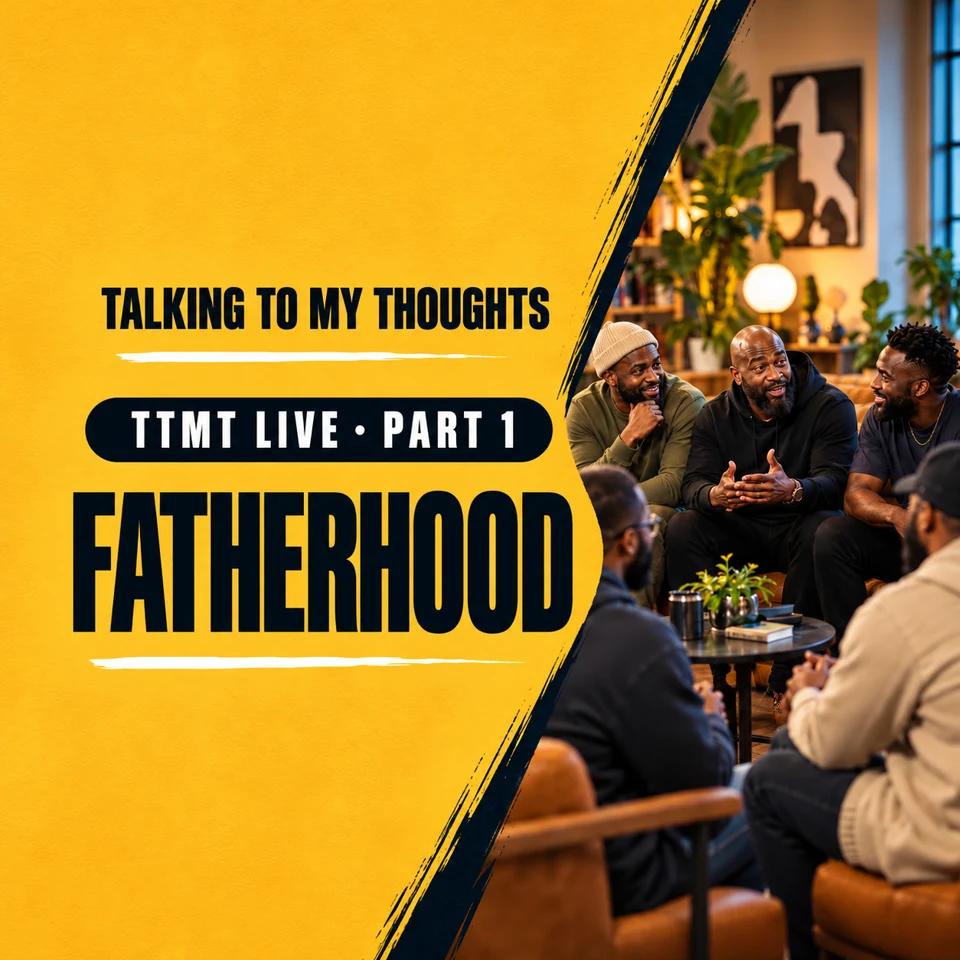
Ayo and Kofi join Craig and Simon at The Wilds for TTMT’s first live podcast. They talk about being present as fathers, the pressure to provide, and what they learned from their own families.
56 min
In this conversation
Part 1 brings the audience into a conversation about fatherhood. Ayo, Kofi and Simon share experiences of raising children, and Craig reflects on what he remembers about being a son. The audience asks about relationships with fathers in adulthood, making time for children, and feeling ready to become a parent.
What the recording covers
- Ayo and Kofi describe being present and setting an example through everyday behaviour.
- Kofi talks about balancing boundaries with play, noticing when he withdraws, and the pressure he feels to provide.
- Ayo reflects on listening to his son, helping him name feelings, and choosing how to spend his time.
- Craig remembers family dinners and being heard when he had something to share.
- Audience questions turn the conversation towards relationships with fathers, planning for children, and making time to recharge.
Questions to sit with after you listen
- When did you feel listened to growing up, and what made that moment stay with you?
- Where does the pressure to provide make it harder for you to be present?
- What small routine gives you more energy to show up for the people around you?
Related
- TTMT Live event recap
Revisit the evening at The Wilds through photos and reflections.
- This Is Why We Celebrate Our Fathers
Craig and Simon talk with their fathers about family across generations.
Transcript
This transcript comes from the published episode and may contain transcription errors. The audio is the source for exact wording.
Welcome and introductions
speaker-0: All right, welcome everyone. Welcome, welcome, welcome to the first ever Talking To My Thoughts Live. Thank you so much for joining us. Big up, big up, big up. Yeah, I appreciate yous lot coming down, man. It's a big thing for us. Myself and Craig have been doing Talking To My Thoughts since 2019. So the podcast is obviously online. Show of hands, does anyone listen to the podcast? Hands, yeah, yeah, yeah.
Cool, at least half the room, that's good. That's a good start. So just to give you very quick and clear idea of the structure of how we typically do the conversations, we have an introduction with our guests, then we have a bit of a warm-up question just to kind of lighten the mood a little bit, and we start off with a reflection piece.
And the reason why we do this reflection piece is because we believe before you can be open with others, you first have to be open with yourself. So what we do as part of the premise of our conversations with talking to my thoughts is essentially we get people to self-journal. So they go into their own space and they basically reflect on the subject matter at hand.
So in this case, obviously it's around fatherhood and co-parenting, just really trying to be in your head and be in your own space and thinking, actually, how do I really feel about this? And it's very different trying to say that verbally to everyone when everyone's just kind of staring at you, like, what do you think about it actually? Just be in your own space, be in a space where...
you feel comfortable enough to be vulnerable with yourself at least. And what we do is then we record those, play that out to the group, and then that allows us to open up the conversation. And then usually we have a bit of a discussion around that, and then we allow a couple of questions at the end before we have a bit of a reflective piece and a bit of something to take away basically from the conversation.
Yeah, so Craig, do you wanna introduce yourself? speaker-3: So yeah, Craig, I'm... I don't know what to say, really. I'm not a father. I'm not speaker-0: Don't be shy man, don't be shy. speaker-3: a co-parent. I'm a web developer, I'm a speaker. do some life coaching, a part of a few businesses, really have just tried a lot of different things. I enjoy a lot of different things.
And especially being in men's mental, men's spaces actually to have conversations. actually realized many years ago that men talk very differently when women are not in the room actually. speaker-0: So yeah, just to very quickly introduce myself, my name's Simon. I have three kids. One of my eldest child is, I'm basically co-parenting the situation. my background is in media.
So I've been working in the event space and in media space for over 15 years. I think for when you're starting anything, you need to be passionate about it straight away, right? So I think for us, was just, it was an easy win for us because we were so invested in it anyway. And it's really just, of gone from a podcast and now elevating into what can we do to make these spaces that we create in the podcast.
available for everybody. It's not just about us. This isn't just us. And really just about empowering each other to be okay with being vulnerable and finding someone who you feel safe enough to have those conversations with. Sometimes, as I said, it starts with you first. You can't have those conversations if you're not comfortable having a conversation with yourself. Cool. All right. Let's introduce our guest.
speaker-3: The first part is going to be fatherhood and we have a couple of guests. One is Kofi, if you come and join us. speaker-0: Come on, Kofi, speaker-1: Hey, hey, hey, hey, hey. speaker-3: And then our second guest and speaker is Ayo. speaker-0: Come on, come on, come on. speaker-3: I'm gonna, yeah, they're gonna share the mic here.
So I'm gonna let them, you guys heard about us, but these are, we picked these people very specifically and we'll let them introduce themselves. So go ahead first. speaker-1: Hi everyone, how you guys in? yes, I've been on the road for two hours. God bless the Darford crossing. so yeah, glad to be here. Thank you guys for having me. my name's Ayle. saying husband to one wife, my dear wife Susan.
Got one son, Josiah, he's four years old. and yeah, I'm a photographer, mentor. I run a men's organization called Four Twelve Men. I run a business called A No Studios. and I also lead a ministry called The New Thing London in Sawditch. And I run various men's things. So I run Something called groom to husband where I help men transition from being single into hus into marriage life.
Also do something called husband circles where guys come to just share how their marriage life is going as well. And that's better of men stuff that I just love doing with men. So that's it in a nutshell. Yeah. Big up, thank you. speaker-2: Yes, yes, it's Goofy. Glad to be here to see some of your faces. So I've got a wife, I've got two kings. I'm raising another Josiah, four years old as well.
And Jeremiah is six years old and another boy on the way in January. I wanted a girl, but I've got over it. All right, I've got to make a football out of one of them. Yeah, so I run a property business. I also coach and mentor entrepreneurs and property people. One of eight, KVG, which we back found us also. And I've worked in tech sales for the last 13 years or so. I've always been interested in men's circles.
I've always thought that men, there's not much attention towards men in society. So when I became a believer in 2010, it was one of the key things I wanted to do with, with gathering all men together. And I've been blessed with loads of great men in my life that I'm proud to work with. So yeah, excited to be on this today. speaker-1: Thank you. speaker-3: You get a bit of a flavor of everybody.
We'll basically be just having some open questions to start with and we'll get into reflections pretty soon as well. I guess I would like to probably start with, this might be a very open question, but what do you think makes a good father?
What makes a good father?
speaker-2: Wow. The deep one there, what makes a good father? It's a great question. Ultimately, someone who's a great role model, someone who's present in the child's life, it's very challenging to be a father. And in being a father, I can understand when many people run away from being a father. because as much as a blessing as it is, it's very challenging.
But I think ultimately you want to be a role model that your child can aspire to be and that people can look back and say, see the values that you placed in that child and the character that they've become. So I think one father there who's present in the child's life and is able to love them and help them grow into the child or adult they were called to be. speaker-1: yeah.
first word that came to mind being a good father was the word being present. And then if I'm t if I'm to just paint a picture, I think a father should be that's good, should be present enough for the child to know that he's there. But also ahead enough to show the child what's also possible. So that tension of like being here and also being an example of what is also possible to be a man.
I think maybe when I think about fatherhood now, especially with my child being four, favourite time I I've being a father 'cause we're we're actually talking. I can understand what you're saying. but realising how much he imitates me in the little things and how much I am subconsciously raising him through my patterns and my disciplines. Well regardless of me being intentional about it or not.
So I'm just like raw my fatherhood is is twenty four seven. Not just when I'm intentionally trying to spend time with him is also when I'm not he's also watching that and It's what I'm doing, is it good? You know what I mean? So that's how I'm seeing it. be present but then also be ahead enough to show him this is what it can be like as well. So yeah, that that's a good father in my opinion.
speaker-0: Nice one, thank you, I agree. I agree with both of those points, to be honest. I think for you to be a good father, first of all, you need to be there. You can't be a good father if you're not there, right? How does that work? So I think presence is the key thing for me. And then it's also about being able to be a good representation of a mature and... A good person, a good human man, a good human being.
It's not even about just being a good man, it's about being a good person for me. I think, yes, naturally as you are a man, you are representing it. You are representation of hopefully what a good man is. I think the important thing is just showing humility, showing like empathy, being... courteous to other people, showing respect.
All of that stuff doesn't necessarily come from being a man, that's just being a person, right? So I think that's the key thing for me is, first of all, being present, to be a good father, and then having all of those qualities as well is important. Okay, cool, thank you for that, that's a good start.
What we'll is we'll kick off with our first reflection, so these gentlemen have recorded a voice note, we'll play that out, we'll start off with, let's go with Kofi first. It was 50-50, bro. It 50-50. And then we'll work it out from there. We'll open up the conversation from there.
Kofi on relationships, vulnerability and providing
speaker-2: For me, fatherhood has been one of the most greatest privileges and responsibilities of my life. I became a dad in 2020. I've got now two young boys with another child on the way. And I think my understanding of fatherhood has evolved quite significantly. particularly as I've started to appreciate the responsibility of not just raising children, but raising future men.
My own experience of fatherhood was shaped by growing up with a traditional Ghanaian dad, very authoritative, disciplined, could be affectionate at times, but you know, not as much as I am to my boys. And... He's present, he's very involved in our lives, probably too much, I felt at the time, but he's certainly very much interested in our...
likes in our development and that's something I've come to respect and appreciate even more as I've become a father myself. But one thing that wasn't necessarily there was the friendship element. There's a clear distinction between parent and child and I think some of that comes down to cultural differences.
I'm British born and grew up here whereas my dad was very much shaped by his Ghanaian upbringing and looking back I don't think there's always, I don't think he always got the execution right in what he was doing but I appreciate that he what he was trying to achieve and doing so and I could see the intention behind it and for me fatherhood is about taking the best of what I inherited and being intentional about what I want to do differently.
I want my boys to respect me as their father. I believe in authority discipline boundaries and accountability but equally I want them I want to be their friend. I want us to laugh together, enjoy each other's company and have a relationship where they feel completely safe to tell me anything. We say this to them, even when they've done something wrong, come and tell me.
And I want them to feel like they can always be vulnerable with me, no matter how bad the situation is. I don't want them to fear my reaction so much that they feel that they have to hide anything from me at all. And I think that's an important balance. maintaining that authority and respect while creating an environment where your children feel loved if you're understood and that emotional security.
I've also become very conscious of the fact that that fatherhood really exposes who you are as a man really really holds up a mirror to yourself. You can have all the ideals about the kind of father that you want to be but life has a way of testing them. And for me, one of the biggest challenges has been navigating the pressure of provision, finances and business.
Over the last few years, there have been some really difficult periods. So I've run a business and as you can imagine, that can be very challenging. Put significant pressure on me. And what I've recognized is one of my coping mechanisms tends to be to emotionally withdraw. So I'm still physically present. I'm still doing what needs to be done, but internally.
almost just trying to get through those moments without allowing my frustration to spill over and sometimes that can probably come across as passive or disengaged and it's something I've reflected on recently and something I've certainly become more conscious of in my marriage but certainly as a father also.
Although my intention might be to protect my family from the pressure that I'm carrying, the weight of responsibility. The reality is that I can become less emotionally available for them. And I don't want my boys growing up believing that being a man means that you never struggle, never have a difficult day. Sometimes I tell them, boys, I've had a tough day. I'm struggling.
And I think that's healthy because it's something that we speak to them about. If one of them's upset or they're struggling, are you struggling today? And they say yes, and they understand and recognize that. So in the same way, I say to them, daddy's struggling because I want them to know that I can be vulnerable.
But at the same time, I want them to see that having a difficult day doesn't mean I have to withdraw, become impatient, or disconnect from the people I love. So that's something I'm actively working on because ultimately they're learning how to navigate their own emotions by watching how I navigate mine. And that brings me back to something I believe quite strongly.
We're not just raising children, raising future adults. I'm thinking about their character, who they've become. Confidence, young resilient men with integrity. That's who I want them to become. I want them to be independent thinkers, to have strong sense of identity, to treat people well. And also become men who add to society, who are going to be leaders, husbands, fathers.
And I've recognized that so much of that will be shaped by what they see in me. A lot of pressure, A lot of pressure. When I think about the legacy I want to leave. course I want to provide for them financially I want to give them every opportunity and the best possible start in life. More than that I want them to reach adulthood and generally just respect the man their father was.
I want them to look back and say my dad was my hero he was my friend he was present he was affectionate he made us laugh provided for us sacrificed and gave us a foundation. I want them to see the different facets of manhood through me.
Not because I was a perfect man or had everything figured out, because I'm not, but because I consistently try to demonstrate what it means to be a good man and a good father, even through life's challenges. And I think that's ultimately what fatherhood means to me. It's about the legacy you leave, not just in what you give your children, but in who they become and the example you set for them.
very conscious of that to become the father I want to be. I have to keep becoming a better man every day myself. speaker-3: Thank you, Kov. powerful. And also thank you for allowing us to just be reviewing your thoughts on your own. I guess the first question will be that what came up for you listening back to it? speaker-2: Yes, deep question is one. As I said, thought it would be easy to go.
I could have kept going, as I said to you. I think the weight of responsibility as a father and... You can only get it once you become a father and you start to see the challenge. But I think as I said in this, you when you're growing up there's things you won't understand what your parents do. But it's the found respect I have being a parent now and being a father, you know, the sacrifices and.
So I said in there, just want them to respect me because I look at my dad and I think I respect you so much with what you did. I understand those sacrifices that I wouldn't have understood at the time. it's recognizing, you know, what fathers do. And also that role model type I speak about is so important. Kids are like sponges. You don't recognize it.
Sometimes when they mimic what we do, sometimes in the morning on the way to school, again, I'm getting annoyed with drivers, right? And then sometimes they'll say it to mom at home. I'm like, what? It's just funny, but they hear everything. they imitate you, especially young boys imitating their fathers.
So I'm very conscious of that, but also conscious of not just showcasing that I've got everything together, recognizing that I am growing also. And that vulnerability, which I think is good because it helps them to be vulnerable. speaker-0: Sorry, we're just gonna, these things just trigger questions. This is what we're about, right? It's a conversation.
So just on that kind of subject, and this is to everyone, obviously I can try and answer it as well, but it's because you specifically brought it up around trying to have that balance with being a friend to your kids. Why do you think that's important? Why do you feel that as a position of a father you need to be a friend? Because I mean typically in the past that's never really been the case.
I feel like that's probably something a mindset has started to change as of recently where we feel like we have to befriend our kids. Whereas before it's just like that's just a disciplinarian. He's the one when you're getting out of line your dad's about to walk through the door you know so better mind yourself because he's about to give you some licks.
So where did that I guess that mindset and why do you think that's important to now feel like you need to be a friend? to your kids. speaker-2: Yeah, I think relationships are important, right? Relationships, all sorts of relationships. And I think in order to help both parties, having a good relationship with your child is important.
So, and that's the element of having, becoming their friend, where you can laugh with them, where it isn't just serious all the time. You can switch to that if it needs to be, right? And having the boundaries and knowing where to do that. And they get the distinction also. But I think it's beautiful. When you see, you see adults.
a daughter and her mother or a son and mother and dad and son and they get on and they meet up and they do things together. It's beautiful, which I'm sure some of you guys have seen. So I think it doesn't just have to be what the majority of us have experienced growing up. I've seen that other side, which is beautiful. And I think where you have a relationship like that fosters the openness, right?
So it's very difficult for people to be open where there is that authoritative figure and just child where you can challenge your parents and your parents can come and say, sorry, that is mad. Can you imagine? can you imagine that parent come to say sorry, it doesn't happen. I've said sorry to my kids like many times. All right. I've said sorry. And it's important to be able to do that. So I think, yeah, friendship.
with your child is amazing. I'm seeing it and feeling it and love what we have at the moment and just trying to build on it. speaker-3: I know I actually kind of just laughing about the not saying sorry. It's like something happens and then the way that your parents are sorry is like yeah dinner already. speaker-2: You can go outside.
speaker-3: One of the key parts that you brought up, which I could probably resonate with, be the being emotionally withdrawn when just life just gets on top of you. And guess subconsciously it sounded like you saw it as though I'm protecting them. I don't want to like pass on my bad mood or... the days a lot, don't want to have to come back home and also explain it.
How, when, I guess the first question would be when did you, when did you first like really discover that or was you aware of that? speaker-2: My wife. Yeah, guess in part, conversations with my wife, which is helpful again. So I, you know, having a partner and being able to communicate and talk and also be open to listening.
Cause if you're in your feelings or you're just doing the defense mechanism, you just might see it as this is what I do and this is normal, right? Until someone points it out and you're like, okay, let me deep it. But I could, I then I sense it and feel myself doing it. right, even happened this week, I was just like, I can feel it happening.
So it's about how do I deal within those moments but still be present and show my vulnerability if I need to, because I spoke about the balance of showing, yes, daddy is struggling at the same time, but also, you know, whilst we might go through struggles, how do we then deal with our relationships? I don't wanna... I don't want to treat you the way that I'm feeling. also I'd notice when kids are kids, right?
They do what they do. They're going to do the same thing whenever. But it's like, why am I reacting more in this situation? And often it's because I'm frustrated about something. And so I look at why did I respond in that way? So even if they need correction or discipline, often I'll take a minute to breathe. And we do this breathing thing where they know it. So sometimes they're not listening about mine.
I start breathing techniques and then they know I'm serious anyway. Right, but it helps them to recognize, okay, daddy's regulating now. The same way I tell them to regulate, I'm regulating. So it's helpful, it's like I'm doing the practice in front of them, which is gonna help them, because I think we've all seen and know kids who then become adults who are not regulated. And it's very dangerous for society, yeah.
speaker-0: I'm going back to what I heard in your voice note. And one of the things that landed for me, which I want to expand on a little bit more, is the pressure. You mentioned about sometimes you feel that there's a lot of weight on you. I want you to try and articulate that as best as you can about what that pressure is and how you, as a father, as a husband, how you really manage that pressure.
And actually, what does that look like for you, first of all? speaker-2: Yeah, I think as a man, especially you feel like your provider. So if you feel like you're not providing in one area, whether it's financially, spiritually, or your presence, it can make you feel a certain way. So I think there's pressure on that side because you could be at home, but you're thinking about how I'm gonna do X, Y, Z.
And that's real, right? You need to do this, a responsibility. So it's harder than compartmentalize, especially if you're working at home and you haven't had time to walk home and actually decompress, right? You're coming out of one room straight into chaos, right? your family need you to be present. And then you have the other pressure that I spoke about because kids are watching you and you're role model to them.
So every little thing you do and a lot of these little things are subconscious. So it's about recognizing, being conscious of what are some of these negative and bad habits that you do, and they're gonna pick up off it. yeah, kids are mad interesting. me and my wife were laughing this week, because it's half term, and our kids got invited round, so you're feeling it half term. speaker-1: Visual view.
speaker-0: Yeah, yeah. speaker-2: got invited round to one of the other kids' house and the kids were playing and one of the kids built something in Lego and then our son Jeremiah said, that's so ghetto. And my wife was like embarrassed and then the other mum was laughing thinking where did he get that from and what does he mean by that and he was like he doesn't know.
And as soon she said it to me I just laughed, I was like yeah you say it all the time, he's got it from you straight. she's subconscious, she doesn't even remember saying it and she would say other things that he would do that he's got off me. It's recognizing that they're sponges. So you have to be careful. But you spoke about coping with the pressure. I think I'm God-fearing.
So first thing is prayer and just trusting God with the weight of everything. Clear weight, just passing on. And I think just... In those moments, recognizing, yes, I could be going through something, but just appreciate the blessing that I have of having a home, having kids, having a wife.
Those things that we take for granted, because you want to do all the other provision stuff, and whilst those things are good, it's like the fact that I can go home to wife and kids and running water and food is a blessing. it's like I look at those small things and the kids just laughing, right? Kids laughing is a blessing, right?
To some kids who need critical, you know, in a critical condition and need, you know, constant care. My kids are healthy and they're laughing, right? So I have to then just be grateful for those moments and be happy and that's helpful. speaker-0: Blessings, bro, blessings, thank you. All right, so we are, thank you for that, by the way. We're gonna move on to our next voicemail and then we'll expand the conversation.
You ready? Spotlights on you, bro.
Ayo on becoming a dad and being present
speaker-1: So I became a dad four years ago. Became a dad four years ago, shortly after the pandemic in twenty twenty twenty-two. became a dad to a baby boy, just size aka. and yeah it's been an it's been a beautiful journey. I'm told often that my face lights up whenever I talk about my son. the journey has at its core has redefined what it means to be successful.
it's created I think if anything's ha it it's it's made me see myself, DNA is real. in new ways, just there's things you love about your son and you things you hate about your son in the context of really the things that you love because you see stuff that you that you're that that would remind you of you sorry and there's things that You see that you don't like the idea of you.
So those are the things that you love and also hate. Which I really think is a humbling experience because then it's very interesting the the the emotional energy that there is behind how you respond to the good and the bad.
and I think, you know, if there's anything that's that's that tests the reins of fatherhood, especially at this formative stage of of zero to eight years old is just the the consequence and the impact of your behaviour, you know.
Really realizing the power of things that are nurtured, you know, and things that are nature, you know, things that are just inward just inward things that need to either be worked on or plucked out, you know, and things that, you know, are shaped through How you respond and the behaviours that children imitate from what they see.
So I mean, being a parent is just like rather consciousness of like I'm I'm I'm I'm of the belief of that, look man, you can be so intentional, which is very important about certain things you wanna do. But then there's there's also the dynamic of also being of understanding that you by default your pattern is raising your child.
So to become the best is to be not just to be intentional about what you want to do for the child. intentional but yourself because w it's you that's raising the child by default. So you know and that fights the need to be a hypocrite, that fights the need for fatherhood becoming a performance.
that fights the need for, you know, yeah, for yeah, it really fights that performative element of fatherhood, which in some cases and contexts is is required because there are because there are child, there are some things that you're going to have to be performative about so for myself if I want I want my child to read, I need to child needs to see me reading and maybe the times that I would normally read might not be the times when he's awake or doing stuff, but I'm intentionally doing certain performances of acts.
That's called what those things to be things that he's also aware of. So there can be a performative and motive in in the when and the how. But that's of course you want it to be things that your child also grows in, man. So yeah man. So So I think yeah I've learnt from my father to give him so much, so much, so much grace, have so much more understanding of his traces, his actions, when you become a parent.
You know, I'm I'm first generation born here. He he even came over here from Nigeria. vividly remembering you know, the the hustle that he had, the grit he had, the grind, you know, I'm I'm talking like going to uni again, night night night shift, taking taking me to school, like seeing the the the level of w I think it's intimidation.
yeah man, the just the willingness to to grow and expand, knowing that by default his growth and expansion as a man is is growing and expanding his family's opportunity, resource and stuff.
So th those were key things that I learned, the the the the the willingness to pay the price, to be forward thinking, to know that maybe the decisions I'm making now that may not understand or may not be my son's happiness, but in the future they'll be able to look back and and and and see the recompense and the quality the the quality of those choices and stuff.
So yeah man, yeah, it does that's the main thing that comes to mind first about what I've learned from my father. speaker-3: Thank you for that. guess, yeah, What came up for you when you heard it? speaker-1: cringe.
yeah, I think what came up I think I was still pondering on on Kofi's one and I was thinking some of the points that I raised about you were mentioned about respecting your father and as we resonated deep with that whereas like, you know what?
Yeah, there were things that But that wasn't maybe as quote unquote present the way that I may desire president to be, but being older, understanding the the sacrifice of why he couldn't be just based on his context of how he grew up here and how he had to work and stuff. So I think was just pondering like you know what, fatherhood for each generation has its own context as to why they did what they did.
And y when you grow older and you become more mature and you become a father yourself, you just have a much more more grace and understanding that yeah maybe there were areas I didn't like or enjoy but I understand why now and and I'm also grateful that you were courageous enough to to pay that price and that price meant it meant that you missed moments but then those missed moments also gave me opportunity to become who I am today.
so yeah I feel like I'm s I see my father for who he is more now as an older son than I did when I was younger. So those were the kinda like the things I was I was thinking about when I was listening to it again and that based on what you were sharing as well. So yeah. speaker-0: I think one of the key things, first of all, did anyone kind of resonate with any messages in there that align with you?
You can just put your hand up or you can say a couple words. I see some nodding, Funny enough, it's a bit of a shameless plug. We did a podcast actually, an episode not too long ago around presence and what that means. And actually it seems like obviously there's a lot of things that align with. what you've mentioned with the conversation we've had previously.
And I want to know from your perspective, obviously speaker-1: Yeah. speaker-0: you kind of touched on it a little bit around maybe your dad not being there as much as you maybe have wanted him to be. speaker-1: Yeah. speaker-0: Now being a dad, what does presence look like to you and how do you kind of replicate that? speaker-1: Yeah, good question, man. my son came a bit late.
So I obviously I freelanced photography, so I kinda cleared my diary when he was born, was supposed to be born. And he didn't. And we to wait maybe two, three weeks overdue. So by that time I had a job to do in it, a chute. So maybe he was like three days, four days. It was then at my parents.
so when I came home from the shoot one time, my mum was there, she was helping my wife and stuff, and she was just like she's like, I I want you to always remember, your child won't remember what you bought him, but he will always remember whether you were there.
She was just trying to like hone in my desire to provide versus also making sure that provision isn't also it's not just what you buy for them, it's also you actually being there with them, create memories and stuff. So I feel like presence for me is like how intentional am I in creating those core memories with my child. presence for me is like can my child see me? Can he touch me? Does he hear me?
Those three areas like 'cause you can be there and not actually be there. You know what I'm saying? So there's this thing of what does access to me look like?
And similar to what you said as well about being able to show the totality of being a man, meaning his definition of strength isn't that I don't share anything or show anything, but I'm willing to do those things and sharing how maybe you're feeling and whatnot are also demonstration of strength because I'm willing to bear myself and you can see that, you know, within reason obviously he's he's four of us, you know.
But at least he's he doesn't have a whooped or toxic, you know. expression of what that looks like. I think that's also presence as well. So yeah, being my best to express authenticity in all of the totalities also being present so he can find language for when he does feel those things. This is how Dad responded. So I have license and freedom to express that being as well.
So yeah, that's what I would define as presence. speaker-0: Thank you. Just on that as well actually, so I've got a question here which I think is quite relevant to that. So how do you define what it means to be emotionally present for your child, so not just physically present, but mostly present while also managing your own daily pressures? speaker-1: how do I define it?
I mean I think not suppressing how he may respond emotionally and being a lot more curious into telling and into asking him so you know like why are you angry or why are you sad, you know. giving him opportunity to give language to what he's feeling, I think is the way I would define that, being emotionally present.
And 'cause sometimes the reality is your child can just children just just do children's stuff and that's gonna be really random. And and you could be having a a rough day. And you're just like you're actually legit getting on my nerves now. You know I and it's very easy to be impulsive, right, with your reactions and so forth.
And once again, like he's like you mentioned real coffee, like the consciousness of like I'm teaching You about your emotions for how I'm responding to you when you're being quote unquote emotional. So it's really tough, guys. gosh, it's really really tough. So I think yeah, being able to clot that moment 'cause it's a millisecond of your reaction, you know, regulate. So I debriefing as well, funny enough.
So I'll I'll say his name that three times slowly. AJ. AJ. that woo and is that yeah so and then tr trying to make light So I tried to make light of things that could easily just become escalate. speaker-3: You was very reflective. There was actually not a lot about your son in there, weirdly enough. There was a lot about you from what I was hearing. You was really...
You was really talking about fatherhood like something that you have to step into rather than it be like what is actually happening when I heard it. And why am I saying that is... Obviously you shared with us that maybe your father wasn't there as much as you might have liked. I guess the question would be, what have you chosen to do differently from how you was? speaker-1: Yeah.
I think my line of work by default allows me to make choices where quote unquote like I own around my time so I'm able to make choices around my time that allows me to do things that maybe, if I didn't have that that liberty that would by default not allow me to be as present as I want to.
So I think that blessing, which I would call a blessing, has allowed me to be way more present where I can I'm at a place where I can choose to say yes or no to that job and just because I want to do this with my son and so forth.
So I think from from early that I was on night shift, you know, from early, you know, sensory class, from early wherever I can just eveiliate pressure from my wife, I would do those sort of things. So yeah and I feel like those things really created our bond that we have till now where all the little things or just being able to do things with him has helped me be a lot more present.
And then at the same time like not defining present as well by how much time but the quality of the time. So I mentioned before about the core memories. So now trying to get him into football. So on Saturdays he knows that's me and him were going to football and he's just doing he's not doing the football. It's a the football literally but at least he knows that Saturday is football.
Like he there's it's times where he's telling me this is what we're doing now kind of thing. So he said yeah and yeah man And it's it's really hard though, 'cause when you're working from home, like He he's a builder, so he builds Lego, he builds blocks and stuff. And like obviously my computer desk is in the in the s in the living room on the on the other side of the kitchen.
so sometimes when he's back from school, nursery well, nursery den, you know, he wants to he wants to play. So like play and then normally he's like, mum, like come play with me and she's like she's tired, she's like, Look, ask her dad to play with you and he's like, No, dad's working as a meeting, so daddy can't play.
I play with you but he's di but then he's like he's he's he's automatically seen that when I'm on a computer, I'm on Zoom, I'm on whatever, I'm working.
So there's times when he has asked me and I'd Yeah, I'm coming, I'm just you know, thingy so I realised that the frequency of those I'm coming or whatnot, and maybe I I don't actually end up coming, he's now saying like, Yeah, when Dad's there, he's working, you know. I I'm my wife, she she's she she would just drop anything and be like, Okay.
She she she let that art off just like two minutes, three minutes and go back. When I'm locked in, I'm locked in. Yeah, literally. So but I can't lie. But when I heard that sentence though, it it it did hurt me a bit where I thought, wow, like, is that this is what you're associated with like that that's not that's not true. You know what I mean? Kind of thing. But I said that's well, that's his experience.
So wisdom now is like, okay, how am I gonna create that to change that, you know, experience that he has. So So that really put a big dag on me when I thought I'd be a president and he's telling me that, that he's working, he he's not cut he can't play right now.
So yeah, so even though I'm intentional other areas, there's also default areas, like I mentioned before, that it's that's also sending him messages about it. You know what I mean? Obviously, he's full, so he doesn't have the full, you know, but that's his experience. So I have to honor that as well. So yeah. I thought I've answered the question, but yeah.
Craig on what stayed with him from childhood
speaker-3: It's your story. It's what you kind of pick up. it actually brought something up for me, Obviously, I'm 36, so I didn't go through no COVID as a kid. And my dad is actually in the room now. speaker-1: Mm-hmm. speaker-3: And one of the key things I actually wanted to bring up was that mom and dad worked full time. And dad sometimes would work seven days a week.
And I always say this every time I talk to you and I think to the man as well. I'm like, I've never actually known that to not be there for dinner or not be there when I expect him to be there. Every dinner he'll be there from. I don't remember him not. coming at the right time. And it's not just that doesn't be there for the mom and dad, for example.
And sometimes I'm a work late, but it was really clear that we working late. But then when mom does finish this, it was 10. Me and dad will go in the car and go and pick her up from her office. And that was, again, a different type of the journey. And it really brought up something that you said is this is that.
I guess what you probably realize is that maybe you consistently told him, yeah, a bit later, a bit later, and then he just turned that into something. And for me, I guess what I picked up when I was a kid was that regardless of how much work there is, had to do seven days, five days, it didn't matter. Dinner was always at the same time every single day, no matter what it was.
And I guess that's actually became a strong core memory for me. And it's always something I think about and hopefully dad will be okay with it. But that's not what mom and dad went through. When they talk about how they were brought up, they never had that. And both of their promises to, I guess, each other and to myself was they will do completely different. That was their intention.
of how hard it is, regardless if you're stuck in traffic, you have to do a lot of work, bills are stacking up, you're sick, whatever it is, that was their thing. They will always be there. And I think another thing I was talking to my partner about was they never... They've never said they're busy. I've never had my parents say that they're busy.
And it's so easy for us to say that today, to say, I'm busy, I'm doing something, I'm gonna call, or I need to go somewhere. What times are you? speaker-2: No. speaker-3: And I guess maybe because my parents didn't have all these side hobbies, etc. So they sent us to Coordination Street. They genuinely speaker-1: Hello, huh? speaker-3: have never said, not right now. I'm busy or I have to do something.
if it was, if they ever did say or even gave a hint of it, I probably would have had the conversation with them like a minute later. And that was stuck with me. Like, again, reflects nobody is just interesting. And it's funny how we would go into like I've been not far there, but to enter fatherhood now, I would imagine that I would be working from home and not to close the door, et cetera. And I'm like, it would be.
Yeah, it would be almost like I would want to be there so badly because I never had that. Yeah. So it's like I had a great version of how a father would be for me and I'm like, when I become father, can I uphold that?
Especially that we have hobbies we have talked to my force we have KVG we have like our own businesses, etc You're thinking I got all these things all because you want to provide but then you're going back and you're like Well, you're taking away the thing that you actually got given I was a gift the thing that's not gonna be the longest.
Yeah, but it's something I wanted to kind of share Because it's it's so easy for us to say we're busy speaker-1: Yeah. speaker-3: or later, et cetera. actually, when I reflect that, like, that was the biggest core memories is dinners at the same time every day, no matter how, wherever anybody is. And the second thing is you're never being told later.
If I have something to say that I have a burning desire, unfortunately, my partner has to deal with that now. Like, every time I have something, I've done something new at work, hey, babe, and she's in the middle of a meeting, anything, and she barely says she's busy. She'll just listen to me in the background. speaker-1: Yeah. speaker-3: Yeah, it's stuck with me.
Audience questions on fathers, time and readiness
speaker-0: Thank you, bro. I wanna take an opportunity if anyone does have a question, we can raise hand if anyone's got a question. AI Voice - SJ: What is the dynamic like with your father now? speaker-1: I got the mic. So yeah, dynamic now. I mean, yeah, i i is I think the dynamic now is that we're able to have maybe conversations that never had like growing up.
Like I I'm Nigerian so you know you don't ask why, you don't talk about you know, there's just certain things that just does you know, everything is order, respect, anything that looks any speaker-0: think outside of that is a problem. So growing up now and just maybe, having your definition of being a father and a friend, I think I've probably seen the transition of our relationship coming from him being a father.
And now that I'm older, there's this element of friendship of like, I can disagree, I can share, and there's reason and stuff. So I still feel, if I'm being very honest, that there could be more like, emotional bonding, things don't need to be just about what we're doing or just, you know. just, know, how men talk, just, what you doing, what you doing, what you doing, where you going?
It was all that, and how's this, how's that, blah, But this could be a lot more about, you know, how you feeling, what's the, what's on your mind now, how you processing stuff. That could be a lot more and better, if I'm being really honest. I think it's something, because I'm doing it with my son, that innately I can see that I also do desire as well.
So, but yeah, man, I think like, I understand my dad way more now, so there's a lot more grace and understanding and like he said, big respect. So that's shaped the conversations now in regards to what we kind of have. yeah, that's what I would say it was like now. Who wants to go next? speaker-1: Yeah, what's it like now? I think it's... there's a respect element in the same way you said.
I think from perhaps that generation of fathers, there is like, are an adult now, so it's a bit different in the way they relate to you. So there is an element of friendship there. I do sort of think it could go deeper. And I think if it had the original from a childhood deeper, it would be easier. I think it just takes intentionality.
doing stuff together, checking in, not it being just transactional, but how are you? And I think even trying to get like, vulnerability out of your father's like the craziest thing. Like, you know when say, how are you? Yeah, fine. You just say, no, how are you? So yeah, I think there's still a work in progress, but I see the, it gets softer as all, right, with age, so, which helps. So yeah.
speaker-2: By the I'm gonna point him out, but that's my dad right there. So just eat speaker-1: original SJ. We have episode with both of our dads actually. make sure to check that out at some point. We had a couple more questions at the backyard. speaker-0: Do AI Voice - SJ: Have you ever considered, rather than telling your kids later or I am busy, putting things in a schedule? speaker-0: Yeah. Yeah. No, yeah.
He's not like my wife, so yeah. Which is why I was just like, yeah. So I'm a hard head. The solution has been like time blocking. So when he's back from school, like no meetings between there and when he goes to bed. So between like five and eight, it's like he's, know, you know, settling down downtime and stuff. I'm now having, cause I was, you know, in my own head, I was thinking, yeah, I'm a time freak.
like to just, but then I didn't actually consider like. the timings of when he's back and he may say stuff and when I'm doing stuff. then I was like, you know, maybe we would just not do your Zoom meetings after this time. So was like, okay. And then, know. know, shorten your day or maybe after eight you can continue and stuff. we did what you said and what she said as well.
So yeah, so then I've completely taken out that language from my mouth completely. I'm fully, you know what saying, present. yeah, so yeah, so I've taken heed to your words, so yeah. AI Voice - SJ: Did you ever plan to have kids or was it something that just happened? speaker-0: Okay, now, wants to be a dad.
Funny enough, when she wants us to start trying, I wasn't interested, like, but you need to pattern some things before. You know, I wanted to probably have my child outside of my flat and move out first and just do, let's have certain things in place. When a child comes, especially my wife, will have to, know, unquote, stop working or whatever.
wanted just to make sure that financially and other areas, things were just, you know, patterned, you know. So there was a bit of, but then we got to an agreement and then, yeah. So when he did arrive at the time he did arrive, I was very open to it, literally. So yeah, yeah, that's all I'll speaker-1: Yeah, same. Ours was planned. It was the right timing.
yeah, was always that we were going to have kids about probably three years into marriage, which it was around the same time.
Making time to recharge and be present
AI Voice - SJ: What do you do that fills your cup and allows you to be present? speaker-1: Good question. I have something called the POS, my personal operating system. And it's part of my routine that helps me to be present in the morning. So waking up first thing, I go for a walk for about an hour, undoing my affirmations, prayer, and just walking off stress as well.
In that morning, come back, shower, journal, do all that stuff before the kids wake up. And what I've recognized, it's helped me to be, I've had some time to myself, and time to power up. now like kids are waking up and first things like breakfast, one's pooing, one's this. It can be crazy. Like, and I've found if I'm waking up near them or not having time to myself, then it like, I recognize I don't serve them well.
So that's part of me pouring in. So then I can serve them better. And it's been helpful. My wife understands. So she'll know even after I put them to bed, sometimes I have to go for a walk. I just need to walk. And she recognized even the playing football. I play football Monday, Tuesday night sometimes. And she knows I need that as part of that I can serve the family better. So yeah, I call it my POS system.
It's in the diary, like the things that I need to do. And it helps me massively. speaker-0: That's good, man. Yeah, so I think this is something that if my wife asks me maybe August or July, I used to have a lot of hobbies. I write a lot. I used to do like journaling, writing, poetry. I used to like drawing and painting, quite a creative person, but based on the business of my work and there's everything.
I haven't been doing lots of stuff. She asked me that, what brings you joy? I'm naming me straight, by the way, in Yoruba. I was like, obviously what brings me joy is that you guys are good, but it's just like, once again, you're tying it to somebody else. Apart from us, what brings you joy kind of thing.
And it's still something that I'm dissecting up until now, but I've realized that stuff like you're doing where doing things that... I like doing for me, which, funny enough, prayer walks have been helping me a lot. So do that after I drop them in the morning. And yeah, I started doing coloring and I just started maybe practicing being a bit more silent. And then silent moments.
birth moments for me to actually journal about things that maybe in my conscious state I don't actually think about, but it's happening deeper down. And I've been in therapy for the last maybe eight months now. So that's really helped, because he's caught me where when he's asking me questions, I always respond with my thoughts, not with my feelings.
So being a lot more creative of what I'm feeling has also allowed me to be a bit more present, because then I'm able to be a lot more self-aware, which then informs me on how I respond. to my family and how I meet their needs as well. those have been a few things that have been helping me out recently to be more present for them. yeah. speaker-2: Nice one. Thank guys. Thank guys for for joining us.
I just want to say we're gonna take a very quick five minute break before we move on to our next segment, There are drinks, there are a bit of snacks as well. Toilets are just to your left. We'll come back in five minutes and then we'll go into our conversation around co-parenting if that's all right.
Related episodes
 EP 32 | Reclaiming my identity (Ft Dan)Craig, SJ and Dan on identity beyond fatherhood, making room for yourself, and boundaries after separation.
- Fathers
- Relationships
- Ep 31 | Co-Parenting - Presence over perfection (Ft Malachi)Malachi Hudson with the hosts on fatherhood after separation: presence, co-parenting, and not performing a perfect parent.
- Fathers
- SPECIAL: This Is Why We Celebrate Our Fathers!A Father's Day conversation with the hosts' fathers about affection, work, masculinity, and Black fatherhood across generations.
- Fathers
- Masculinity
Scope and support
We offer reflective practice, not therapy, diagnosis, legal advice, mediation, or crisis support.
If you are at immediate risk, feel unsafe, or need urgent specialist support, pause and use crisis, emergency, or safeguarding services that can hold that properly.