Podcast episode
Ep 31 | Co-Parenting - Presence over perfection (Ft Malachi)
Malachi Hudson with the hosts on fatherhood after separation: presence, co-parenting, and not performing a perfect parent.
68 min
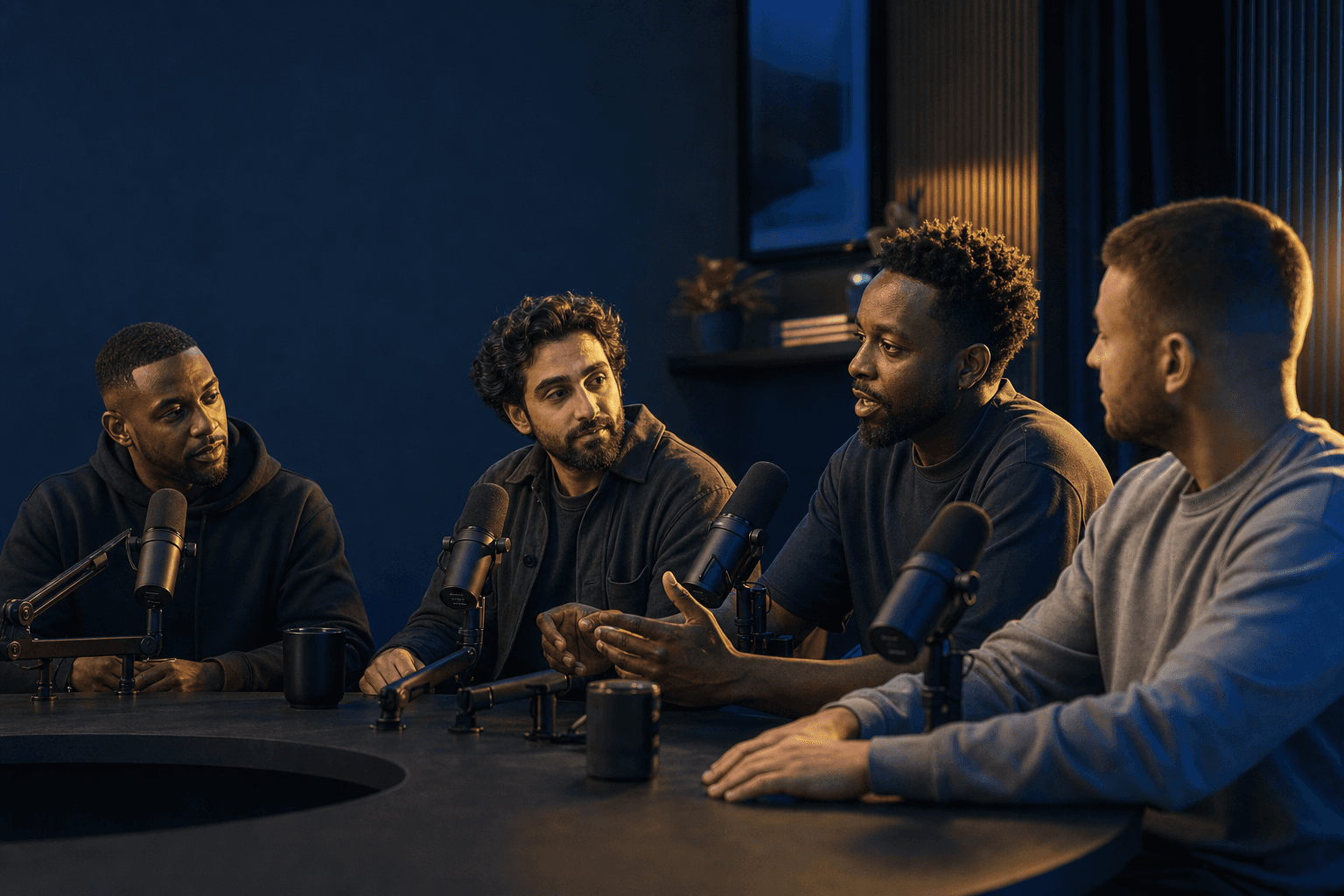
In this conversation
This guide follows the published episode notes. The notes describe personal experience of separation and co-parenting, and a preference for being present over being perfect. The full transcript is available below. It is not a parenting plan, not legal advice, and not mediation.
What the episode notes say
- The notes put presence ahead of perfection in parenting.
- Malachi and the hosts speak from separation and co-parenting, including the emotional strain.
- They emphasise intention: how you show up, not a performance of having it together.
Questions to sit with after you listen
- Where are you trying to look like a perfect father instead of being in the room?
- What does presence look like on a week when the arrangement is strained?
Related
- Co-parenting fathers reflection guide
A free email set of questions. Not a plan for care, contact or legal decisions.
- Men during pregnancy
An earlier fatherhood conversation, from the months before a child arrives.
Transcript
Automatically generated transcript, with paragraph breaks and topic headings added for reading. It may contain transcription errors. Speaker labels are included where supplied by the source; listen to the recording for tone and context.
Introduction and guests
Craig Riviere: welcome to Talking to My Thoughts, the podcast where we have open, honest and raw conversations with a twist. We bring a unique perspective on our thoughts by literally pre-recording the things on our minds before talking about them with the group. We do this because we believe before you can be open with your with others, you first have to be open with yourself.
So please stay up to date with all our content by following us on our socials at talking to my thoughts. And make sure you guys listen to the end to hear our responses to some of your thought provoking questions. Okay. So firstly, my name is Craig. I'll be one of your hosts. SJ: Yep, and I'm SJ co host. and obviously we are joined by our guest today, Malachi. If you don't mind please introducing yourself.
Malachi Hudson: Yes, people. So my name is Malachi Hudson. I am thirty one, just turned thirty one. And I'm a father of one. And yeah, I am someone who loves fatherhood, someone who's an advocate for fatherhood and I started my own page in relation to fatherhood called Father's World.
And yeah, I'm just loving the journey and I'm appreciative of you guys holding a space like this so I can come on and and talk about these things. Craig Riviere: thank you so much for joining us. And we honestly, sir, it's it's an honor to have you here with us as well, especially as someone who's so passionate about being a father as well. It's super important to these kind of conversations.
So before we get started and jump into the conversations, we would like to give our listeners an opportunity to get to know our guests just a little bit better and start on the front foot by answering the first question. This is called Cards on the Table. shameless plug. We have a pack of our conversation cards. Malachi Hudson: Mm-hmm. Craig Riviere: Soon will be available on our website as well. so let's start.
Simon's gonna flick through the cards and when you say stop, then it that is the one that you get to have the question on. So go ahead, Simon. SJ: Ready? go. question is what has life taught you about taking risks and discomfort? Craig Riviere: Colour. Malachi Hudson: That's a good question still. What's Craig Riviere: Okay. Malachi Hudson: life? That's deep, but first one, you know. But you know, let me warm up.
what has life taught me? for things to work, you have to work. You have to work. I'm obviously a big believer in my faith and but obviously in the Bible it says faith without works is dead.
So I think, you know, it it's alright saying you believe in this, you believe in that, but I think at the same time, without the risk, without putting in work, without taking these chances I think you're not gonna get to where you wanna get to or where you could or should get to. So that'll be my answer for that one. Craig Riviere: I like that, that's the right. I gotta remember that one man, I'm gonna play this one.
No, thank you. SJ: Ha ha ha. Malachi Hudson: That off the dumb, that's that's what will come to mind, SJ: Clean. Malachi Hudson: so Craig Riviere: No that's how it's supposed to be. No, thank you, Mom. so we'll get straight into t today's topic. The fear of losing a connection after a separation often leads fathers to overcompensate with gifts, lax rules, or constant entertainment.
This discussion can highlight how everyday consistency and emotional presence build deeper, longer-lasting trust that can than weekend spectacles. So we're gonna get into it. Presence over perfection. Let's Let's start by digging a little deeper. We're pretty much gonna get straight into the recording.
So, as you know, we always get our guests to pre-record themselves talking about the topic that's already at hand, and we will kind of get into the thoughts of what they were saying to themselves, really, which will be more insightful than you think. So, we're gonna start off with SJ's recording. So we'll play it out and then Manakai, everybody just let me know if you can hear it. All right.
Fatherhood after separation
Thank you for sharing that Simon. That was yeah, that was deep man. Malachi Hudson: Deep. Deep still. Yeah, it's real, bro. SJ: Thank you, bro. Thank you. yeah, I guess yeah, my ther my first thing on that I guess would be just really just honing in on that point about not trying to be perfect. Like just really I think at the time and and just for context, obviously my daughter's a lot older now. She's she's sixteen.
But when when I separated from her mum, she was three So this was a long time ago and she was quite young. And obviously At the stage when we had separated, I think maybe just before I wasn't working or I was working infrequently. So I was very much present a lot of the time. I was at home a lot of the time. So to go from being at home a lot of the time to almost not being at home was a big shift.
And I was very adamant. One of the first things I said was, What What are we gonna do about this routine? Like what's happening on the weekends, what's happening during the week, 'cause I was obviously doing school runs and stuff like that. and I think that's where a lot of friction came in because trying to set that routine when there's I don't know, hard feelings, there's there's emotions flying around.
It's like I even want to see you, I don't even want to talk to you. Malachi Hudson: Mm. SJ: so yeah, it was difficult. But I'd l I'd love to hear obviously Malachi from your side of things, maybe what resonated and what you thought about at least hearing that first that voice note from myself and and what you think about it. Malachi Hudson: Mm, yeah, I resonate, bro.
Obviously, I think when you guys play my voice out as well, you'll hear how at a time I struggled with sorting out these type of arrangements. I sorted I struggled with the separation and trying to be there for my boy, but also us us, his mum and I need an R space. so I resonated with that heavy. And I also resonated with the fact that you yeah you did what you needed to be doing to be there for your daughter.
and was adamant that you're gonna put your foot for put your foot forward and and make that happen. so yeah I I respect that a lot 'cause like I said, I've been there myself and obviously in the voice note you spoke about presence. That's that's me bro. That's my main thing. it's I think you'll hear that in my voice note as well. The main thing is just presence, just being there. just showing up as much as possible.
so yeah, I I respect that a lot, bro. SJ: It's interesting where that actually comes from because I almost think to myself, if I wa if I wasn't around as much as I was at the start before the separation happened, would I still want that to be or would that still be as important to me when we separated, if that makes sense? I'm almost almost Malachi Hudson: Mm.
SJ: thinking to myself, is it w was it a case of I was trying to hold on to something and hold on to maybe a a level of normality? Craig Riviere: Okay.
SJ: Or was it a case of like if it was the flip side and I was someone like a dad that was always working, always traveling, never around, and then I separated from my ex-partner, would it still be a case of would I still wanna be around or would I not wanna be around and then how that would look?
I think for me it was always, I guess I don't know where it came from, if I'm honest with you, but it's just always been instilled in me to be like whenever, whenever I have kids. Like I just have that that out of belief that for you to be a good parent, for you to be a good dad, first and foremost, you need to be there. With we're we're trying to we're trying to reverse that narrative, right?
Especially around black men not being there for their kids, not being around. You typically hear of of people talking about that their dad wasn't there, their dad wasn't around, that it's always a narrative that you hear across the board around the world and it's like that's not gonna be me. That's definitely not gonna be me. Malachi Hudson: Yeah, yeah, yeah.
SJ: So yeah, I just really I d I don't quite know where it came from, but I've it's always been a very strong belief, probably even before I was a dad, to be like if I even have kids, there's no way I'm not gonna be there. This it's just not an option. Malachi Hudson: I think I think that's it, bro. I think some people get it confused and feel like it is an option. SJ: Mm.
Malachi Hudson: because if we're if we're discussing the mother now and she's thinking, like, you know, if we separate, am I still gonna be there or not? Yeah, even most people are gonna judge her even if she's thinking about thinking about that. Because for a mum, you're just expecting her to be there. And why is it why is it any different for a father? Why is it any different for a dad? Do you understand?
It's not it's not optional, it's not yeah, it's not a choice, it's that's your child, you're there. so that's why I say I respect it, bro. And 'cause know some dads forget that and think that it's optional and have a child separate and now they're not with the missus, they think, Okay, cool, now I've got a choice.
I didn't really sign up for this, I wanted to be with the missus, so I'm you I'm not really gonna see my child like that. But to me that can't run. So I say the reason why, probably just 'cause it's a natural thing to do, but just to be there for your child.
Just like any mother, just like any parent, so Craig Riviere: I'd like to I don't know if it's like play the edge game like the like a devil's advocate kind of thing. So I heard in the voice note obviously respect that you was able to be present, that was your choice and you probably made the decision subconsciously beforehand. I guess from getting core values from your family before you even had a kid.
But also in the voice note you actually said that, Like I didn't I didn't have no peas. Like I ain't have no money to me do no SJ: Yeah. Craig Riviere: I can't do not overcompensate it 'cause I ain't got no P's. I ain't got no money to do that. And I I I wonder you would never I guess we'll never know, but maybe it will maybe draw the answer from you as to where it might have come from.
That let's say it was later in your your years, or maybe like you was already deep in work from eighteen all upwards and work was just flourishing. Well, you could overcompensate. Where you did have other responsibilities already, or where you was already older so you already saw what you want in the world. You think you would choose differently? SJ: Very good question, actually. That's a very good question.
Maybe, you know. Potentially. I think so. It's was it's it's what's accessible to you. Go on. Malachi Hudson: Wait, so so so w you asking would you would you choose to be present or would you choose to spoil spoil your daughter on these things? Yeah. Craig Riviere: E either w either one really, two two parts. One is that if he had money, would you have chosen potentially to overcompensate before he found presence?
Number one. And then the second one being that, well, if you had other things going on, obviously you that was quite young for your first daughter, which means that like you're still fresh out like you hadn't had a found a career yet, you haven't found yourself yet. If you had yourself and your your career and money, do you think you would have chosen differently?
And I'm not choosing it to s to to to challenge the the presence part. I f I think that's super disrespectful and a lot of men would like to be there. And a lot of men would not like to have to convince themselves to be present to that level. Whereas a lot of men are doing that right now. But I'm wondering if you n if you can think, why do you think?
Or what was that turning point where you was like, I'm I'm gonna be here no matter what. SJ: Don't know, I there wasn't really a turning point 'cause it was, as I said, it was always instilled in me. I was, even when I was when we was a family unit, I was always gonna be there no matter what.
So regardless of what that situation was, we was whether we was together or we wasn't together, that for me wasn't gonna change. And that was quite important for me to try and emphasize and kind of keep at least that part intact in terms of me being there, me being present, keeping that normality and keeping that routine to kind of show that. This that nothing can separate us. Do you know what I mean?
Like nothing's gonna stop me from being around. Like nothing. Like there shouldn't be anything that's gonna stop me from doing that.
I guess the question around if if I was in a in a better position in that in that time of my life, financially or work-wise, career-wise, potentially things would be different in terms of how I occupied that space, because I would still be present, but what my presence looked like would be probably be a little bit different, if I'm honest with you. Maybe in terms of taking her out more or doing more thing.
As I said, I kind of made that bit of joke about me saying I can't do those things 'cause I ain't got the money. But obviously if I did have the money, yeah, we can have theme parks every other weekend and whatever. And I guess that's that's not it's not to show off. It's not to kind of get one up on your ex partner or whatever. But actually it's more about I don't have as much time as I used to have.
So Now within this little window that I have, I'm gonna do as much as I can. And it Craig Riviere: Yeah. SJ: I guess it is overcompensating, but it's like I don't know when I'm gonna get an opportunity to do this. Whereas beforehand I had as much opportunity as was available to me. I was there every single day. So if I decided, you know what, on Wednesday, let's go to Fort Park, we could do that.
Now it's like, Well, I'm not seeing you on Wednesday. In fact, I'm not even seeing you on Monday, Tuesday, Thursday or Friday. I've only seen you on two days. So Craig Riviere: Mm. SJ: those two days I'm gonna make it worthwhile. And that's that's all it was. So yeah, I guess it would be slightly different if I had if I had the one funds available to do that.
But the key thing around that, even though yes, I'm we're going out and I'm she might be getting spoiled a little bit more, the key thing around that is creating memories and be in prison. That's the that was the key thing. Craig Riviere: Appreciate it. we won't go too much into that discussion 'cause we have one more. Of course your voice note, Malachi.
Malachi on being present
So let's continue and kind of bring it into what yours is and how it kind of resonates and maybe where there's any differentiators or difference in timing as well. So let's get into it. Thanks for sharing that bro. It's good to get a bit Malachi Hudson: Of course. Craig Riviere: an insight into just your thoughts about it, man. What did you what did you pick up from hearing it back?
Malachi Hudson: I thought yeah, obviously the the main f I didn't talk about perfection at all. I did in in certain ways in terms of n I'm not the perfect parent, obviously there's times where y the thing about him drawing me out when I'm on my phone and these things. and even to bring it back, even when the r the relationship with his mum ended at four months is very early, something that I didn't plan for.
This is a result of me not being perfect. You know, these kind of things. So I didn't necessarily mention that but it's in there. But the main thing, obviously the emphasis as Simon was saying is on presence, you know, and being there for him. And even when we separated and and and at a point I mentioned she stopped me seeing him just for context.
It was like I was seeing him but it wasn't as I should have been seeing him. So at that point before that I was seeing him every other day. Obviously with the nature of co currently can't be there every day. So it was like every other day at that point. And then it became four times About four times a month. About four times a month. So I said Yeah, I said no, that that for me that can't run.
For context as well, his mom and I live fifteen minutes apart. my work is based around him. so yeah, and I've always been there for him, so there was no reason why that should change now to four times a month. So that's when had to apply to court and, you know, really push to be in my son's life. more than what I was at that point. 'Cause for me that wasn't that wasn't it.
It's not what I was used to and it's not what I was gonna be used to. So yeah, with with love and respect I had to do that and we get on now as well, just for context. and even them times when it was difficult. Craig Riviere: Yeah.
Malachi Hudson: Because of my love love for my son and my understanding of how I need to go about it to be present, that also brought about a l love and respect for his mom as well, even at the most difficult time with my son in mind.
you know, to not let it go left in any type of way and not to argue and these things and make sure I'm doing everything possible, even thinking of those type of things, so that I can be there for my son.
So yeah, that that's kind of what's coming to mind of w when listening back, just the importance of presence and being in SJ: Actually it's actually interesting because obviously you as you you said kind of the separation happened when your son was quite young.
I'm I'm interested to know what presence looked like to you at that time, now being from a s in a separated household as a dad looking after your son who's only four months. What does that presence look like at that time compared to now when you're saying you work out, you go to church, you read the Bible? Malachi Hudson: Mm. SJ: when they're four months old, is it's a different dynamic, right?
What did that actually look like for you for you in Malachi Hudson: Yeah, yeah. SJ: terms of being present? Malachi Hudson: For me, just just being there, holding him. obviously I the in the earlier stages, our our job which I I wasn't fully aware of at the time, is more so based around mum, I believe, in my personal opinion.
making sure mom's okay, helping mom after such, you know, going through something like giving birth. however I was I think I was at the time I was mostly focused on my son and just being there for him and just looking to hold him and do things with him and And and yeah, just be around him really. and yeah, I would say obviously when we split I was still trying to see him every day, so still going there every day.
But like I said, I think obviously it got to a point where I realized we myself and his mom needed space from each other. so as much as I wanted to be there for him, I realised okay. He's gonna have to now come with me, come to mine. Well I was I was gonna went back to my mum's house. He's gonna have to now come back to mine, and be around me but here.
So see she can have her space, I can have my space because it was it was we're getting on top. So yeah, I think in in them stages I think it that's when it that's when it it dawned on me that yeah, I can't be obviously going there every day still. and I need to now create an environment here at my mum's house. Which I call home, but at at home for him to come here and you know, we do the co parent dynamic from there.
but yeah, of course, obviously the dynamic as you mentioned is very different. Things we do now we obvio we of course couldn't do then. but yeah, for me it's just holding him. Just I used to watch football with him and my with him in my lap, with him in my arms. We used to take naps together, all these kind of stuff. obviously feeding him when mum when we was expressing and things like that.
So Yeah, it's very different, but it's still very, very important until to be there at them stages. Craig Riviere: I'm always gonna be the one that's gonna come with fighting. SJ: Yeah. Malachi Hudson: Got you, man. Craig Riviere: The first things I'm I'm I'm hearing when I listen to it is obviously split out four months is quite early. Malachi Hudson: Yeah.
Craig Riviere: my first my first question would have been like, well my first thought, you don't have to answer it or you don't have to answer it all actually because it doesn't necessarily have to be part of this conversation.
But is like why really, like why would you what f what what what I'm hearing is like you you obviously had a relationship She you had your son together and then all of a sudden Malachi Hudson: Mm-hmm. Craig Riviere: like it sounds like your whole focus just shifted on your son and the relationship was like it did its part, now I have a son.
in a sense obviously that's not how it comes across how it would have been, but how did you end Malachi Hudson: Hmm. Craig Riviere: up ending at four months, which is earlier of course. And then the second part would be I guess we've watched which is what I was trying to get out of Simon, which was what type of man was you at that moment then versus now? is Malachi Hudson: Mm-hmm.
Craig Riviere: and and the reason why I've as important is because there's two parts of what's happening is there are parents right now who are fully in their kids' life and they don't have the same presence. Even if they're right there, they don't have the same presence, they have the same distraction. If anything they may be taking it for granted.
Of course you guys have experienced something different where you're like you're Being restrained, and you're like, right, I need to make the most of this. It's like it's amplifying your want to be a better father, which is why overcompensation comes as a word. And then the second Malachi Hudson: Mm.
Craig Riviere: part is like, we know so many parents and probably previous generations who stayed in a relationship simply because they wanted the kids to have a family unit and how important that was. I'm wondering if there was a case in your minds where you're like. I don't want to do it that way, if that ever came up in your mind.
So I have to split or I have to end it, regardless of how tough it's gonna be, and what's to come. I'm just trying to understand what was the man that made the decision, in reality. One is leaving the relationship. If you want to answer that, you'll have to. And the second is where you just find you found all of this.
share will, share like fire in you to say, I'm gonna do my best by my son and every habit I may have, picking up my phone or doing things alone or whatever it is, my son is going to be my main thing I think about. Malachi Hudson: Hm I appreciate those questions, but I'm very honest and open person, so yeah, no issues in answering them.
so at the time was when I was with his mum, you were together for two years, I was obviously slightly younger and yeah, a bit immature, so there some things, there were some old habits and things. So long story short, in a sense I was I was cheating on his mum in the earlier stages of the relationship. and this is like over the phone stuff, just for context, but nonetheless cheating, right?
And I think we then kind of moved on from that and then we yeah, we're saying a two year relationship, had our son and all these things and I I think yeah, after our son I think kind of some of these things was coming back up and it was kind of getting on top.
so yeah it we were just we were just some of those issues were coming back up along with f being first time parents along with it wasn't just us two together we was living with her family and all these things which we were very grateful for but yeah there was just a a lot of factors obviously you know there's things like postnatal depression and all these things that I'm not even aware of at the time.
I have no idea about these things. Craig Riviere: Mm-hmm. Malachi Hudson: so obviously with the nature of giving birth it's it's it's a lot on a woman's body. and in my mind I'm thinking like a few days later now like you're good you're good to go, like everything's like SJ: Yeah. Malachi Hudson: babies here now, what can't. Craig Riviere: Yeah.
Malachi Hudson: but yeah, like I said, I'm just like so focused on my boy and that and so happy to have a son here and this, that and the other. I'm not really, you know, his mum was mentioning doing the small things for her. But long story short, yeah, it's just a lot of things I think was happening at that time and it just got a bit too much, so we was both over the moon to have a baby.
and yeah, I think it just got to a point though where, you know, it was just tough for us to be around each other. She was changing, I was changing. We were both kind of I think declining in how we were as individuals. so then coming together the energy was just off. I was thinking, you know, baby's gonna pick this up.
This is not good, this is not how shit let's just let's just 'cause it was ongoing for a little while. So I think even just before baby was here, so I just said, okay. You know, as you mentioned, I was it I I'm heavy on that bro. I tried for many years after by the way to to make it work 'cause I'm heavy on the one family and everyone being under one roof and things.
But yeah, got to the point where I said, Okay, this this ain't good. Like where we're at now is not good. And Craig Riviere: Mm-hmm. Malachi Hudson: it wasn't getting any better. so I said, Okay, cool. L let let me do the let's make this decision and then, you know, hopefully put all the other stuff to the side. We both love our son, let's be there for him and these kind of things.
And yeah, it didn't quite go that way to begin with, but like I say, we are where we are now, we're in a good place now. and Craig Riviere: Mm-hmm. Malachi Hudson: we cop we co parent very well. So and then I think does that answer that answer the first question first part of the question? Yeah. Yeah. Yeah, Craig Riviere: Does appreciate now honestly, we definitely heard all of that. Malachi Hudson: yeah.
And then the second question, I have an amazing relationship with my dad. I've always looked up to my dad, I've always loved my dad to bits. as much as I love my mum, but I think just obviously yeah fr from a father's perspective, in terms of being a a boy and a man, I think yeah, I've always had yeah, admiration for my dad in terms of how he is and how he was as a father.
So I've always been so ready to be a father from I say I was like twenty two when had my son but yeah twenty two, twenty three. But yeah, I was I was so ready. and Yeah, so I think as as Estee said, it was kind of just just within me. Like it's just something I've always wanted. and yeah, I was over the moon when when when that time came. So for me, I guess it sounds a bit boring 'cause it's the same as Estee.
but Craig Riviere: No just Malachi Hudson: but but yeah, it is what it is. That's how I felt from from before I had my son. I I was so ready and I was determined to be the best father I could be, obviously. We spoke about presence over perfection. Like I said, I just mentioned some of my imperfections already from from before he came or when he came.
but yeah, never perfect, but I was always over the moon to be a father and always trying to improve as a father and as a man from from them kind of times. So yeah, made a lot of mistakes and and I guess the good thing is learn their mistakes. Craig Riviere: Mm-hmm.
Malachi Hudson: but yeah, I would say very heavy on being present from from from the earliest stages from from pregnancy, really talking to him in his mom's tummy and all these things. So yeah, bro. Craig Riviere: No, really appreciate that, definitely. I'll let Simon share his part as well. But it's not about it being boring at all.
I I like I have I guess maybe other people like what about us kind of thing 'cause I have a good relationship with my parents as well. I'm my only child Malachi Hudson: Yeah. Craig Riviere: I love my parents to bits, both of them, quite equally. Nobody believes it but very equally. And I Malachi Hudson: Mm, mm, mm. Craig Riviere: also like saw my dad treat my mum like a queen from from day dot all the way through.
Malachi Hudson: Break. Craig Riviere: Dad used to work seven days a week and I never knew when he was he wasn't there, like he wasn't present, he was there for dinner every time. So I I really get Malachi Hudson: Yeah. Craig Riviere: that. and I think it's good context for other for the listeners to kind of understand well, how does a man just know that he wants to do this?
And I and I want people to understand that even if you came from a a strong background where your your father was around, wasn't around, you never saw him much or you did. you there is from what I'm sensing from both of you is that there was still a choice. It may not be when that you saw that choice. You never had like this cutting off point, but there was a choice.
And yes, the choice is backed by a very strong example, a strong attachment to your your your father or a strong family grounding. But regardless, it is a choice that's that's there. And I want others to understand like if they feel like they want to be strong in their in their kids' life where they feel like this these stories are inspiring that you made it work no matter what.
It's the fact that there was a choice involved before it happened. Because it doesn't matter and there's not ever there's not a strong correlation that everyone who has a strong family background that their great fathers afterwards. There's a there's a Malachi Hudson: Yeah. Craig Riviere: opposite part to that as well. But yeah, I really thank you for sharing that man. Simon man, what's your Malachi Hudson: cost.
SJ: It's interesting because you d that last thing you just mentioned, Craig, about choice, even when Malachi was speaking about it earlier. I think the the the the notion that we have about what a father is, in our eyes, and I'll speak for myself, I won't speak to Malachi, but it's like there wasn't a choice. Even Craig Riviere: No SJ: though technically there was, there wasn't a choice.
We did I didn't give myself a choice. There was no choice. Malachi Hudson: Mm-hmm. SJ: Like there's there's no way like I can turn around and say I've got a kid over here. I've got nothing to do with them. I don't even know who they are. Like that's never gonna happen. Like that's not a choice that I'm gonna make. So I think that's that's the important thing right there.
Is yeah, and it and it goes back to again whether you're looking at your dad being present and being like, I wanna replicate that, or actually being your dad wasn't around and actually being, I wanna be nothing like that guy. I wanna be the complete Craig Riviere: Mm-hmm. SJ: opposite. And I guess it just it's about your decisions, your right, and your choice.
But for me, there was there it was it wasn't there was no choice.
I guess one thing I I would I it's something I I kind of wanna to kinda spin on his head a little bit and understand from Malakai's perspective 'cause obviously he hasn't he hasn't yet spoken about it, but where he's at now in the stage of his life when he's talking about this platform he's creating around father's world, how he really got into that space and why Malachi decided to to really push that narrative.
I guess from being where you was in a as a unit in a family household having your son to then being in a separated household, kinda going through the court systems and really fighting to be present in your son's life to now creating this space where you're like you're shouting from the rooftops about being an advocate for dads and forefathers and where that really how Malachi Hudson: Yeah.
SJ: that how that kind of evolution happened and why you decided to kind of put that together. Malachi Hudson: Mm. So yeah, obviously I mentioned the beginning, I've always been willing and over the moon about being a father. And yeah, the fathers world stuff came from just that from loving being a father and I share a lot of things on socials, like my fitness journey and all this kind of stuff.
I play football, I share a lot of things and I I believe in sharing my faith and and all the things that I love. So how much more should I of course share fatherhood as well, 'cause that's something that I really love. and I love sharing my experiences with with my son and all of these things.
But a big part of it, father's world actually came from the the court situation, the difficult times in my life 'cause I was quite depressed then times going through court and not seeing my son as much as I should have been. But at the same time I was having conversations with fathers here here and there, individually.
And some were going through court, some were going through their own personal situations with their children's mother and these kind of things. I was thinking, hold on, I'll speak to one father and I'm thinking, hold on, didn't my man just say that he was going through the same thing like two weeks ago? And I didn't want to speak to so and so they said that they were going through something like that.
And I just thought, hold on, let me Instead of speaking to these fathers individually, let me try and get everyone in the one space and we can just talk about it. Craig Riviere: Mm. Malachi Hudson: So that's literally how fathers came about.
and then yeah, just literally wrote something out on my notes to saying I'm bringing fathers together, let's have a chat about it, put it out there and see who came and then we've about five or so fathers come through. just sat down around the table. It was literally in my house, just sat down around a table in my house, had some food and and just spoke about these things.
everyone just was comfortable to open up and just safe space for us as as men, as fathers to just talk and yeah, just been growing that just been growing that since. so yeah, that's how it came about through through the difficult times. Craig Riviere: It's powerful man.
Family expectations and listener questions
SJ: Beautiful, Craig Riviere: we're the part of the podcast where where we really just pull some questions from other listeners, and any that don't get through today, we'll definitely try to answer them on socials and other ways. But there are a few questions that we have that are yeah, they're they're throwing a a mix into into things.
So Alright, so one of the questions is there is a lot of unspoken guilt around the loss of the traditional family unit. How do you give yourself permission to grieve the life you thought you'd have while still showing up for the family dynamic you have now? Malachi Hudson: fixed SJ: Why? Craig Riviere: Yeah. Malachi Hudson: That's that's that's that's big still. I I struggled with that for years.
I struggled with that for years. Even with all love and respect to his mum, we're we're my son's mum and I, we're very different people and yeah, we're not the same people as we were when we were first together and when we had our son. And but for years because of that feeling of nah I I think I think for me it comes also from my parents, much I love both Mum and Dad. They split from early.
I had to do the split Christmases, split this, split that. and I I think I think for me that that was deep. So I never wanted that for my family. I never wanted that for my family. and there was there was like a sense of guilt and you know, such disappointment and disbelief that rah, this is actually me. Like I hear about it and I've seen it, but me in this situation. It's it's dark.
and because I'm so heavy on family and things as well, it's like it was really tough to get over. Really tough to get out to be honest, took me I don't know if you guys would do the math but it took me about seven years. yeah. So this is this year pretty much I've I've I'd say I fully came to terms with it to be honest earlier this year. but yeah, difficult, difficult.
But I think you really have to understand, you know. as much as it sounds good and looks good and these things being under one roof, sometimes it's just genuinely better that you are not. Craig Riviere: Mm. Malachi Hudson: and you still can can have love and respect the other parent. my son's mum and I we still do things together by the way.
We're not together, but we still maintain some element of family like holidays, his birthdays shared, Days out, yeah, cinema trips, all of these things. So with Craig Riviere: Thanks. Malachi Hudson: all love and respect, as much as we're not supposed to be together like that, we still have an element of family and love and respect between us and our son loves it.
So yeah, I think those things kinda for me have really helped to yeah, move on from that that that realization that okay, I'm not gonna have the one family life that I really wanted and thought about having. So Craig Riviere: Thank you.
SJ: this is probably a separate topic, but I'll be interested to know how that dynamic would look when you basically get into a I don't know if you are in a long term relationship with someone else and still doing that kind of spending time with your son's mum.
I won't we would let's not go into that 'cause I've yeah, that's a that's a whole that that that might be a whole different topic, but yeah, I definitely think there's really, really. wow. Malachi Hudson: Mm. Yeah. I'm I'm there now to be fair. I'm there now, yeah, yeah, yeah. But yeah. But yes. SJ: Okay, cool. All right, cool. Craig Riviere: Couple.
Listeners are gonna be SJ: so Craig Riviere: like, No, hey, hey, what see what season two SJ: Innit, where you go in, innit? What? Malachi Hudson: After you SJ: But yeah, for real. yeah, from my side, I guess it wasn't really I don't know if guilt is the right word for me. I guess Craig Riviere: Yeah.
SJ: more so it was 'cause it wasn't like the guilt of not having what I wanted and then because of that dynamic now shifting and kind of going through a a sense of grief. I didn't have that if I'm honest with you. It was more a somewhat embarrassment. Somewhat embarrassment in some respects to be like, I'm the one that didn't make it work. Like I'm not I'm the one that's like here with my kid.
Everyone else has got their family unit and I'm I don't. so I guess it was in a sense a bit of embarrassment. But I I guess the reason why I probably didn't feel as as guilty about it is because I was quite I was quite adamant that I did as best as I could. And Craig Riviere: Mm-hmm. SJ: it kind of got to a point where there was only one result at the end of it.
And I I made that decision myself and I made the decision to obviously separate. and I thought that was done in the best interest for us. So yeah, I didn't necessarily g feel like I went through a grieving period. It was actually more of a sense of this is gonna be a transition into something which hopefully is gonna work out to be better. And that's how I kinda felt about it.
Craig Riviere: Quite interesting with both of your powers where the the what the the question says traditional, which is obviously stuff that's common and what you expected. And you mentioned embarrassment, which of course is a is down to a comparison. You're comparing it to other people's units, what it looks like it's supposed to be.
and it's funny that from how I'm listening, it's like use that word brave or courageous, which obviously can be very controversial if other people. Certain listeners will listen like, I don't believe that, but you courageous to make you basically chose a path which isn't the traditional path.
Because you didn't just say, I'm gonna leave and then that's it, I'm not gonna do anything with the family or the kid, which is that like the way you just give it up, you self-sabotage.
You was like, Not only am I gonna make it work with my kid, no matter what, I'm gonna be almost just as present or more so than I was when I was there, but also I'm gonna go through the the trials of not knowing what it's gonna look like when I say that I'm not gonna be in your household anymore.
Because obviously there is no I'm sure in father's world you would recognize all the men have had all different stories about how co-press has gone. It has gone in their favor, Malachi Hudson: Yeah. Craig Riviere: it hasn't. Some have had to take legal advice, some haven't, some have had Malachi Hudson: Yes. Craig Riviere: to go through the family emotions, some get back with them, some don't get back with them.
There's like so many dynamics. That means there's no clear path, which means you had no role model, no person to say When I leave, I know what path I need to take next. You're just you just went out in the battlefield like, Okay, well I'm Malachi Hudson: Mm. Craig Riviere: leaving and she's like, Well, anything can happen now.
Especially that we know again, just to highlight this to the the which is hopefully I'm prepared to say this, is that a lot of the time the they they they don't necessarily side with the father naturally to to have ownership of or or custody of the child. And naturally a lot of people who look at a relationship and then be like, What did he do?
and they're gonna be like, okay, well what what was what was what did he do wrong? And and then they're gonna think, yeah, well it's actually better that she's they're with the the mother, not with the father. For there's so many things that I hear, and that's just on the outside. I'm not even a father or someone that's gone through that.
And I can't imagine the kind of things that you had to go through in that transition in your own head is the worst enemy of all of it. But also what other people might say or questions that people are asking like That doesn't sound like a question, that just sounds like a statement. About SJ: Mm-hmm. Craig Riviere: and Malachi Hudson: Mm-hmm. Craig Riviere: it it to me it's courageous that you took that path.
You you saw that the relationship wasn't working. You know all the things you was trying to avoid, not having to a broken family unit, not having to repeat a a cycle that you've experienced, and still you took it anyway, in hope. Remember it's just hope that it could just make it better. And you didn't know what type of man you were gonna end up being during that process as well and what you were gonna go through.
I guess a good question to follow from that before we get to a one more question is would you do it all again in the same way? SJ: I mean, obviously it's in hindsight, right? You look at it like fifteen years down the line and you're like, all right, cool, it w it wor it things worked out, things are good.
Like, obviously there's there's naturally I guess points in your child life that they're gonna they're gonna remember. It it's it's gonna affect them in one way or another. But I always believe that I did as best as I could to put my child's best interest first. And that's why it was about being present, right? We go back to the topic we're talking about, being present.
and I think just where the space that I was in, that not even the space that I was in, the space that we was in, as in you're looking at as a family unit, It was it just it wasn't working. And as I said, I I feel like we did enough to try and make it work where it just to got to a point where it's like a decision has to be made. We can't continue to live like this. A decision has to be made.
And so yeah, I do think that I would I would probably make the same decision. it's again this it's you do whatever's in your control, whatever happens externally is is out of your control and that is what it is. And I'm not happy how things transpired at the time in terms of how we worked things out to get to where we are, but at the end of the day, maybe we had to go through that to then get to where we are now.
Maybe. But I would I wouldn't change it. Craig Riviere: Pretty sure. How about you, Malachi? Malachi Hudson: Brian you just said everything that I could possibly say, bro. I'll be so honest. Literally SJ: Okay. Malachi Hudson: everything you just said is spot on bro, literally. So I I can't even add on that, but yeah, I just agree a hundred percent with Craig Riviere: Perfect. No problem.
Alright, we'll get to one more question and then we'll we'll try to get to wrapping up. So Ooh. if Simon knows news knows I've put the controversial one again. SJ: Yeah. Craig Riviere: If you had to pull a card right now and answer the hardest question about Co Parenting Journey, what is the question you hope isn't on that card? Malachi Hudson: What the hardest so the hardest question about copain?
SJ: coparent in journey that you wouldn't that you wouldn't want to answer. Craig Riviere: Yeah, the hardest question about you that you you wouldn't want to answer it. What is the question? Not the answer though what is the question? SJ: okay, I think I have one.
Would did I'm trying to try the right words, but I guess the the question somewhat is do you think you did what you did to be present out of love or out of a necessity, out of pressure? Do you truly think that you did it out of love or because you just felt like that's what the world was telling you you had to do? Craig Riviere: That's a good one for you because obviously you've said that there was no choice.
No choice. It's all you knew. So you you're now you're so there's like a bit of a qu like this background thing is like Did was it because I love my child child so much that I did that or was it because I felt like there was no other way and it would just yeah, and you couldn't accept any other way.
Malachi Hudson: I I would say yeah two that came to mind is like tough question would be like did did you pick the right person? SJ: Mm. Malachi Hudson: and also was it was it was it your fault? Craig Riviere: Mm. That's questions that you wouldn't want to wouldn't want to have to answer. SJ: Yeah. Malachi Hudson: That's that's that's what's just coming to my mind right now. Those are like tough questions, I think.
Craig Riviere: Respect. Malachi Hudson: Yeah. Craig Riviere: the the thing about both those questions is again it's it's it it goes back to your choices, right? Like did I it's you're always gonna question it, did I make the right choice? Even though Simon Malachi Hudson: Yeah.
Craig Riviere: actually you before we had that that last question you said you'd make the same choice again and then and then now you're also like, huh, but did I make the right one? Malachi Hudson: Yeah. But yeah, that's a that's a it's fun it's funny. I agree with Simon as well, but even my question's like it's like yeah, quite reflective.
Making the most of time with your child
But no, I I I b I believe I believe that made the right decisions and yeah, grateful for how it all turned out to be honest. Craig Riviere: I I I think my my last part before we kind of come to like wrap it up is that D what what type what like what caliber of father did you use like amplify into or multiply into or lessen because of this journey? So let's say you didn't leave your partners, let's say it did work.
Would you sort of been better f better father better obviously is in quotation clear subjective? Would you have been better fathers knowing that they weren't being pulled away from you, you wasn't juggling their time, you wasn't having to fight for them? If they were just there, right there the whole time. Malachi Hudson: Mm. I I I think I wouldn't be the father I am now. I'd be I think maybe a slightly less father.
I think I think having your child and I it's I think it's I don't know, it's not I can't speak for everyone, but I think having your child there every day I think sometimes you can really take that for granted. and you can really as some one of you guys mentioned that earlier and I think you can Y you kinda yeah.
Time in it, time is so important and something that you can't get back and as SJ mentioned, like when you with the nature of co parenting, you don't have all the time in the world with your child, you're not there every single day. And that really does that really did for me make a switch like real. Like I I believe so heavily in what I'm doing, in how I am as a as a as a man, as a father. Craig Riviere: Mm-hmm.
Malachi Hudson: And I believe it's gonna help my son so much, but he's not with me every day for me to implement these things. So it kind of switched something in me, okay, I really, really, really need to lock in on this time because I have only half the time with him.
And, you know, I believe these these disciplines and these these values and things to be so so important that I only have half the time with him to instill these things that naturally I would have been doing every day. so I might I s I I still was a good father at the beginning, I believe. he's my mic's degree. But Craig Riviere: Yeah.
Malachi Hudson: I think we kinda we kind of obviously I could say do things differently. But I think I was a good father. I was there, I was present. and yeah, even like I say from from pregnancy I was doing doing my best. I wasn't perfect, presence over perfection. I wasn't perfect, but I was there, I was doing my best and naturally over time I think You should change anyway, you should grow as a man, as a father.
and I think that's what I've done. I've im I've improved as a man, first and foremost, and then as a father. But I think it definitely made a difference for me, when separated and not having every single day with my boy. So Craig Riviere: Mm-hmm. Malachi Hudson: yeah. SJ: Yeah, it is but like I said, a lot of what I was gonna say, I think I think one of the key words there is is not taking things for granted.
Like when you're with them twenty-four seven, you do take that time for granted. And actually there's the the the sense that you have and the feeling that you have when that separation comes to play and you haven't seen your child in like, I don't know, a week and then you Craig Riviere: Yeah. SJ: see them.
And the the the the feeling, the kind of like euphoria, the happiness that you have in that moment it's like we gotta make this is a special moment. We've got to make memories now. We've got this is this we have to make this this feeling last, right? And then they go away and you and you feel depressed and you feel down and you don't see them again for like another week, for example.
And then you see them again the next week and it's like, my god, okay, cool. Now we have to do something again. Now I think you don't have that when you're with them twenty four seven because you see them every day. You see them wake up, you see them go to sleep. You see them wake up, you see them go to sleep. It's just like okay, it's another day. that's that Malachi Hudson: Mm.
SJ: feeling that feeling doesn't necessarily exist in you to be like, my God, I haven't seen it's it's that sense of you you miss your child, innit? You haven't seen your child in Malachi Hudson: Mm. SJ: so long and you actually miss them. You you don't really get a chance to miss them when you're with them all the time. And that feeling is very different.
So I think in terms of how maybe in terms of what you become, I guess, and how you kind of develop as a father once you're now in a separated household, you're right. It is a sense of overcompensating in some respects and just really trying to make that time count. That presence is even more important because you're not present twenty-four seven anymore.
You're still present because you still see them on a regular basis. They're still a routine, but it's not as often or as frequent as it was before. So it's even more important to make sure that that presence is known by doing stuff Malachi Hudson: Right. SJ: within that moment.
Whether it's going to the park and playing football, whether it's watching your favourite T V show, whether it's just playing games, cooking together in the kitchen, whatever it is, it's really making sure that every moment you have in that one weekend period is special.
Malachi Hudson: I just wanna add as well, like obviously you guys mentioned in description, obviously presence of perfection, and then you mentioned some things in the description and it was like lax rules or just just pure entertainment and all of these things. And I think I kinda went the other way with it.
It was kind of more so like I just mentioned a little bit, but just to elaborate, like when I'm understanding he's not with me all the time, I think it was even more important to establish these rules and disciplines and not be lax but increasing the discipline, increasing the structure, increasing the routine and make sure I'm on job because I know he's only with me half the time now.
So I only have a small amount of time to not have fun and do all of these like nice things but make sure that I'm do I I'll I love being a bad guy to be honest 'cause I know in the future it's gonna benefit him. Like I know in the SJ: Yeah, yeah. Malachi Hudson: future it's gonna benefit him.
I know he he's a mum when you see him him with me I know if you guys see my social thing, you think, like some b a lot of people say, he's such a daddy's boy. I love the relationship you guys have. My son is the biggest mummy's boy you ever seen. But Craig Riviere: Yeah. Malachi Hudson: for me i I like it's cool.
I I know what I'm doing, it's so important and you might not even understand it yet and this, that and Craig Riviere: Mm. Malachi Hudson: the other, but you know, there's certain things that he's just doing now, like this, just naturally because over the years I've drilled it into him and you know, I really value that. I really understand the importance of that.
So for me, yeah, knowing the you know, the fact that he's not with me already, I think it's even more so important to to not to not ease up but but but push. Craig Riviere: That's good. That's good. And again, I think the way you you've Malachi Hudson: Yeah.
Craig Riviere: done it is something to to like look up to is that you're not telling him to do the things, you're showing him and making him join with you in doing those things. So he's showing that Malachi Hudson: Mm. Craig Riviere: the it was the the man maker flake, so you you're showing that this is what it takes to be a man and he's sh sharing Malachi Hudson: Yeah. Craig Riviere: that same value with you.
So he's not gonna I guess well maybe he does rebel from it at certain points, but he's gonna realise that you're not being a hypocrite. about it and you're not Malachi Hudson: Mm. Craig Riviere: like just you're not like on your phone while he's like out here having to pray and and do his workouts and stuff like that. You're showing him what it is. Malachi Hudson: Bro, bro, he he would not allow me to do that, bro.
Like I said, he this the way SJ: Yeah. Craig Riviere: Yeah. Malachi Hudson: the way this guy G checks me, but obviously he's allowed to. We we got that we got Craig Riviere: Yeah. SJ: Yeah. Malachi Hudson: that accountability, so Craig Riviere: Good. Malachi Hudson: he's a he's allowed to. So yeah, yeah, yeah, yeah. No, I'm grateful man. I'm grateful. Craig Riviere: Good.
Alright man, this has been an excellent conversation. we just like to usually wrap up these comments. There's so much that we've spoken about. I know that I heard this is gonna be a season two now. I guess SJ: Yeah. Craig Riviere: the main thing here is like what did we I guess take away from the ki conversation? What is like your one food for thoughts from all that's been heard? I I guess okay.
Malachi Hudson: Mine would be mine mine would be just to encourage any fathers just to understand the importance of of presence and being there. Mine would be even just a reminder for myself, just to make sure, you know, am I still doing all the things we we just spoke about. so even even just a reminder for myself, making sure becoming the best version of me and I'm you know, putting in a hundred percent of my time.
But I don't have a hundred percent time with him, but when he's with I'm putting in a hundred percent. of that small time that we have, so half the time that we have. So yeah, my my biggest takeaway is just to remember and just a reminder for other fathers, just to make sure you're making the most of that time.
Whether you're with your children every single day, you know, and as SJ said, you might not miss them 'cause you're there every day, but just don't take it for granted. and even though you're there, make sure you're present and in the moments and spending that quality time.
SJ: second that as well actually I think one of the biggest things for me is is because you you kinda come out of that space right you're in you're in that kind of a space of of uncomfortability and discomfort and stress and and kind of really trying to work out how you transition to get to a point where you're happy, your kids are happy and and things are kind of working out.
And I think now getting into that space is really as as Malachi said, not not taking it for granted. Like really just being reflective in How I am now being present in a different way. Whereas before in those moments where we were separated or I wasn't seeing my child for a a long time, I was I was I was quite intentional about how I was being present in that space.
But now how am I being intentional in the presence that I'm in now? The space that I'm in now and how am I being present now. So I think it's really about just not really taking things for granted and making more time and making more memories. Yeah, and not not doing it as infrequently as I have been, I guess. So yeah, that's that's the key takeaway for me. Craig Riviere: Appreciate for it from both of you.
skills trying to come on Malachi Hudson: Yeah. Craig Riviere: by me. so I guess my my what I've kind of picked up is regardless of the mistakes, the lack of perfection, the things that you do, the things that you haven't learnt, everything is still a choice in i at at the in the end of the day.
But the key part about it is that it's okay to take the un well they say the the path that hasn't been walked on much and use or d you're did that. And I guess that doesn't i it's not because I'm just s simply talking about as a co-parent, but even if a father is in the relationship and they are like right there you don't have to do it like how everyone else did it.
It doesn't have to be done in the same way that you might have been brought up. It doesn't have to be done the same way that everyone's saying that you're supposed to do it. But the point is if you can stick to your I guess your faith, stick to what you believe in and stick to what you feel like is gonna make you a better man, it probably is gonna make a better a better outcome.
Both of you have made really hard decisions and I'm sure many others who are listening have made hard decisions and they can come out of it on the hindsight saying, Rah, it was hard it was a tough journey, but you'll still do it do it again. And that's a big deal. That was a big deal because it it it was a turnaround for your your life and your kids' life as well.
So Just testament to that, and well done for both of you. And thank you for sharing your, your, your journeys as well. So really appreciate it. Malachi Hudson: No, much appreciate, man. I appreciate the space and and the time that you guys allow me to come on and share these things as well and what you guys have shared and the way you've run it as well. It's big, man. Appreciate it.
Craig Riviere: Definitely we SJ: Thank you, bro. Craig Riviere: got we gotta come down to it to one of your talks, man. It would definitely be good to hit SJ: Yeah, man. Craig Riviere: to hear it. Malachi Hudson: Yeah. Yeah, please do, man. Craig Riviere: Yeah, definitely. thank you again, listeners. I hope you enjoyed the conversation. I hope you guys were just kind of tuned in.
But as you know, this isn't a platform that is just about us talking to you. We want you to be able to get involved, ask questions, continue the con conversation and open to were open up to us about your views and experiences. and this could be from both men and women as well, 'cause we're just we're just interested in how you lot took this conversation and what thoughts came from for you as well.
but if you enjoyed the podcast and want to do something to help us out, please consider liking, sharing and remember to follow us at Talking To My Thoughts to stay up to date with all our new content. Thank you for listening and Malachi and SJ, massive thank you for your thoughts and all of what you shared with us today.
Related episodes
 TTMT Live Part 2: Co-parenting (Ft Royston)Royston joins Craig and Simon at The Wilds to talk about co-parenting after separation, keeping children at the centre, and making room for difficult conversations.
- Fathers
 TTMT Live Part 1: Fatherhood (Ft Ayo & Kofi)Ayo and Kofi join Craig and Simon at The Wilds for TTMT’s first live podcast. They talk about being present as fathers, the pressure to provide, and what they learned from their own families.
- Fathers
- EP 32 | Reclaiming my identity (Ft Dan)Craig, SJ and Dan on identity beyond fatherhood, making room for yourself, and boundaries after separation.
- Fathers
- Relationships
Scope and support
We offer reflective practice, not therapy, diagnosis, legal advice, mediation, or crisis support.
If you are at immediate risk, feel unsafe, or need urgent specialist support, pause and use crisis, emergency, or safeguarding services that can hold that properly.