Podcast episode
Ep25 | Am I Man Enough? Questioning My Masculinity (Ft Joss Cambridge-Simmons)
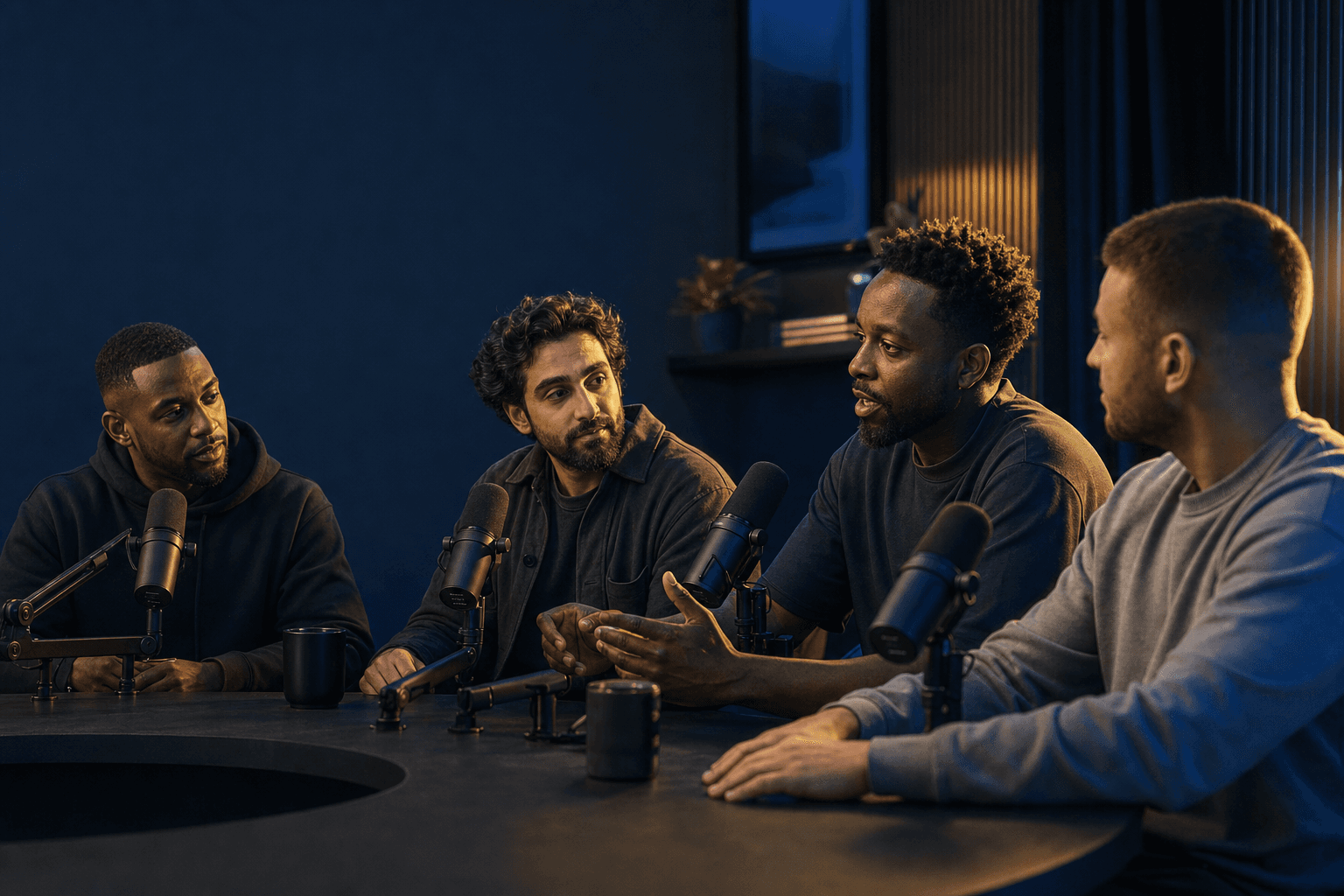
Craig, Simon and Joss Cambridge-Simmons on masculinity that does not require you to perform being strong.
63 min
In this conversation
Joss talks about being soft and still standing up when it is time. The episode questions the instruction to 'be strong'. It is not a definition of manhood you have to pass.
What the recording covers
- Joss says he does not know what being a man is for anyone else, and that telling someone to be strong can dismiss what they feel right now.
- They talk about giving from an empty tank, and how that becomes self-sacrifice rather than love.
- The thread keeps returning to the self: you cannot love anyone properly if you have not given yourself any time.
Questions to sit with after you listen
- Where are you calling numbness strength?
- What would you say if you were allowed to sulk before you were asked to be fine?
Related
- When do I become a man?
An earlier conversation about the same question, with Ebenezer.
- Adult reflection workbook
The manhood chapter is there when you want to write, not only listen.
Transcript
Full transcript generated from the episode audio. It may contain minor errors; use the player for tone and context.
I don't know what being a man is for anyone else, brother, like, I'm the softest soul I know, and I stand up when it's time to stand up, sit down when it's time to sit down. Doesn't make me any less. Because we're not out here screaming to the man to be soft, but out here screaming to the man, especially, be strong. Do you know how dismissive I find it to tell someone be strong? It's gonna be okay.
Even if it is gonna be okay right now, Simon, you feel like crap. You wanna cry, you wanna sulk. Sulk, big man, sulk, sulk. This is Talking To My Thoughts. Welcome to Talking To My Thoughts, the podcast where we have open, honest and raw conversations with a twist. We bring a unique perspective on our thoughts by literally pre-recording the things that are on our mind before talking about them with the group.
Now, we do this because we believe before you can be open with others, you first have to be open with yourself. Now, stay up to date with all of our content by following us on our socials at Talking To My Thoughts and make sure you guys listen to the end to hear our responses to some of your thought-provoking questions. Now, my name is Simon, aka SJ. I'm a proud St.
Lucian, I'm a proud father of two, and I'm also a content creator. My name is Craig, aka Mr. Positive, a cheesy motivator with a St. Lucian background, big dreams, and a passion for helping others find and maintain their peace. Yes, and we are thankful today to be joined by our special guest, Joss. Please introduce yourself. Hi, guys. St. Lucian is really in the building and loving it.
I'm Joss Cambridge-Simmons, founder of JossiCare, and a believer in love. That's who I am. Yeah. Powerful. Wicked, man. Cool. All right, so before we jump into our conversation and talk about a topic we're going to talk about today, just to give a little bit of insight for our listeners, a little bit of background for you, Joss, and just to find out where your mindset is at, I'm going to pose you two questions.
What is the one skill you think that everybody should have? There isn't any, because everybody isn't everybody. The fact that I can DJ and play music well doesn't benefit you if you can do it. You might not want to be able to DJ, and you're not being your authentic self, so there isn't a skill in that aspect.
When we're talking home training and being able to cook and clean and look after yourself, I would put those up on the pedestal and say, it's nice if each individual's confident and comfortable enough to do it, but they're all subjective, so I'm not going to sit here and say, yeah, the men don't need to know how to cook for themselves, because that might not be your forte.
You're going to have to cook for yourself at some point in life, but it might not be your strong point, so I wouldn't want to stress it. So if there isn't anything per se that I would say has to be a skill set, because there's no individual living in that. There's no being true to yourself, because your skill is your skill, whatever your skill is. Cool. Alright, second question.
What is the greatest lesson you have learned about life so far? That love conquers all, man. Love is the strongest energy ever. If love wasn't an Avenger, it would be Thanos, it would be Captain Marvel. I'm a big Marvel fan, so I'm using that example. Love will get you there. Love got me to where I am now in life. Love literally is the conqueror of all for me, man.
That's the biggest lesson that I've learned, and a lesson I'm still learning. It's not a lesson that you learn once. It repeats itself in many different forms. Getting a good job, getting fired, falling in love, having children, starting your own business, following your heart, traveling. We all get different. All of those things fill up our love cups, I call it. Yeah, love. My answer is love, man. Perfect.
With that said, that's obviously good that you've mentioned that, because we actually happen to be recording on the day of love. It's Valentine's Day. But today's topic is a little bit different to that. We're actually going to be talking about masculinity. Oh my God, I can't say this word. Masculinity. We're talking about questioning our masculinity.
Basically, just to give a quick insight or description as to what we would describe it as, it means the qualities or attributes regarded as a characteristic of men. Now, as a sort of a word association and as few words as possible, Josh, when you think about masculinity, what's the first thing that pops into your head? Being open, soft and me. Craig? This being me. Being me. I'd have to ditto that actually.
So I guess when you think about it, yeah, you think masculine is, and it's different because when you were younger, when I was younger, I had a different association or perception of what that was. But I think now at the age that we are, I guess it definitely is about accepting you and who you are and just defining it as you. So I definitely agree with that. Masculinity. Perfect.
So we're going to go into our first recording. I'm going to play mine first and then we'll just open up the conversation from this. If there's any questions, if you've got any insights or experiences that you want to share based on what I've spoken about as well, let's get in, man. So I'm going to play mine first.
I guess as a man, it's something that you constantly are in a battle with yourself, about your self-worth. Are you meeting your expectations? Are you meeting the external world's expectations?
I guess once you get to a point where you're comfortable, you're confident, you're happy, I guess that's the point when you can kind of be self-aware and acknowledge what type of man you are or that you are a man when you get to that realization. I'm not quite sure when that happened for me, but I guess there's always a level of potentially about who you are, who you feel you want to be, who you should be as a man.
Are you strong enough? Are you smart enough? Are you kind of meeting those criteria that you set upon yourself and I guess the rest of the world sets upon you about what you should be in order to be a man? So yeah, I do question it. I think everybody does.
I think I've definitely got to that point at least in later years of just being happy being me and being happy being myself and just getting to the point where, you know what, it's not about what the rest of the world thinks about you and what the social expectations are. It's about what you think of yourself. Are you happy? Are you confident? It's not about the qualities that people expect you to be.
It's the qualities that you have for yourself. I'm happy being a man I am and it was a journey getting to that place. I guess the question is why do we put those things on ourselves and other people? I guess a lot of it comes down to laws of attraction and what I guess as men historically have deemed they should be in order to be attractive. They should be strong. They should be tall. They should be powerful.
And that's probably something that's stemmed over the years. But well, it's arguable to say that in this day and age there's different types of qualities that are now more attractive whether it's empathy, being able to be connected with your emotions a bit more, kindness, being gentle and I guess historically those are the things that were deemed to be weak in a man. So yeah, there's a lot of questions around it.
I think I've now just come to the point and just come to terms with the fact that you just have to be able to accept yourself and who you are and not compare yourself to others as a man. You are a man. There's so many different types. There's no dominating characteristic to say that this is what you need to be to be a man. Accept yourself and accept others for who they are.
Quite interesting because it was definitely like a transition while you was kind of speaking because again, you didn't know when exactly the transition happened. But while you was doing the recording, you was kind of going through the motions of what it felt like to be a man or what you thought it was versus what it is now.
And I guess the real question would be, do you really think that there could have been a definition that you could say that other people would resonate with really, like the majority would? From your processes of going through it, do you think you have a definition of what is masculinity that the majority you think would probably accept?
Yeah, because it's probably the same thing that I believed I needed to be to accept myself. And that comes down to a lot of it comes down to strength. I think a lot of it comes down to strength is, again, talking about the voice note I brought up it. History kind of dictates that you're a man's man when you're strong, when you're powerful, when you're tall, you can hold your own. You're dominant.
And that's what I guess a lot of people will comment commonly. Oh, my God, I can't say my words today. A lot of you know what I mean, that basically people attribute with being a man. You have to be strong. So that's what I probably also wanted to be. And what would resonated with a lot of other people is that, yeah, I get it as a man. I get it.
You feel like you have to be strong, but you can't be strong all the time. It's just it's not possible. You can't. And there's so many different strengths. It's not it's not always a physical strength. It's an emotional strength. It's you know, there's so many different like, how do you measure how strong you are? Like, where is that? It's so complex.
But I think the underlying thing is that it boils down to how strong you are. It seems like the stronger you are, whether it's mentally, physically, whatever else, dictates how much of a man you are. I'm not saying that's right. I'm just saying that that's what I associated with. And I believe that that's a lot. That's what a lot of other people would have said they associate with themselves as well.
I'm going to ask you a very interesting question then. If you have a nephew, you do have a nephew, and they asked you, Uncle Simon, what does it mean to be a man or what is masculinity? What would you say to them? See, that's a hard question. That's a hard question. Go ahead, Joss. Joss has got his finger out like he's ready to say something.
As a teacher in me, I would say to the, like I say to my kids that I look after, girls and boys, boys and girls alike, it's what you want it to be. Especially in this age of now where it's non-binary, we have transgenders, we're openly open about being homosexual. It's like everything's normalized now.
There's no way we can be out here spinning the narrative that this is how you be masculine, this is how you be a man, this is how you be a woman, this is how you be feminine. Literally, we're out here making our own versions of it, and it's kind of cool. It's actually easier. It's still a struggle to find ourselves in life because life happens quick.
But in hindsight, if we bring up our children or the next generation to just accept who they are, they might find it easier to find themselves than we did because there's less social constructs because social constructs are kind of going bit by bit, bit by bit. We're struggling with them more than the next generation will because it will be normal to say, I was born a boy, but I now want to be a girl.
So with masculinity in line, like, okay, me being masculine is wearing pink and wearing purple and wearing yellow and wearing green and wearing black on Fridays. Cool. I'm happy, I'm content. My wellbeing and mental health is intact. We're good to go. I think it's literally, and I realize making things, simplifying things, I get that from children as well. It's simple.
It's way more simple than we think it is, but adults complicate everything. So I like that he said that it's a social construct, basically, because when the social constructs are created, it now causes a pressure to fit into it. Because the whole point is that the world is trying to define you. They want to understand you, so they're trying to say, okay, Simon is a black Caribbean, he's a man, he's this.
They need to put you in categories so they can understand you. Most cases, because of human ego or adult ego, they want to be able to predict what you're going to do next, in a sense. That's why the world does it. But if you start to, everybody just starts to say, I'm me, I'm me, I'm me, I'm me, they don't know where to put that.
They don't know where to put what slot to put it in, what category to put it in, which means that you're unpredictable, which means that you can't be controlled, you can't be, there's a lot of things around that. So it's very interesting that when we first started, we all said be in me, which I assume at this point we have probably quite a bit of self-awareness for us to say that.
We have quite a bit of self-awareness for us to say that. And in your part, I asked you two questions. One question about masculinity as yourself, talking to yourself. Then I asked you the second question about masculinity talking to somebody else, a younger person. Because you would take more care in saying the right words to a younger person knowing that it could change their life.
But we don't take the same care with ourselves because as adults, again, Josh just said it, we are struggling with the social aspect of it, of what we were taught and trying to change it to actually just being me. Whereas newer people, like the younger generation now, are originally just being taught to be themselves. And then Simon, so Simon, instantly you showed it.
You literally just, you went, OK, well, yes, it's about being strong and stuff like that, right? And that's kind of what I was taught, so I kind of go by that. Then I told you, OK, well, what would you say to a younger person? You're like, oh, no, oh. So it's really interesting that you picked that up. But yeah, Josh, go ahead. What did you think about that?
There's a saying that I heard some years ago and I say it and I say it to women quite a lot. Baby girls don't let the world harden you. And it's not to baby girl them off because the same goes for men. We've let the world harden us. We've let the world make us immune to pain. We're out here trying to run away from getting hurt. We're out here trying to match energy. So I'm dating Jane.
Jane doesn't call me, I don't call her. Or like, Jane's a bit off with me today. I'm a bit off with her. And we kind of match the energy like that when realistically, it's not beneficial. And in the aims of masculinity, for me, that all kind of aligns because that's not me being true to me. I don't want to ever match anyone's energy.
You sometimes feel like you have to because you don't want to do too much because they're doing the most. And then sometimes I want to speak up and then you might not even care to hear me. So I'm going to feel like a bit of a fool for speaking up. So I get why sometimes you might revert back in. But masculinity tells me to be true to me. Stay true to me.
And that's why I said be soft because we're not out here screaming to the man and then be soft. We're out here screaming to the man especially to be strong. I'm telling everyone be strong. And you know how dismissive I find it to tell someone be strong. It's going to be okay. Even if it is going to be okay right now, Simon, you feel like crap. You want to cry. You want to sulk. Sulk, big man.
We'll fix it when you're ready. I don't understand any other way to do it because you're going to cry. You're not going to cry forever. You're not going to be sad forever. You're going to be sad for a certain amount of time because time is the best healer. Time is the best fixer.
And being masculine for me is being soft, being genuine, being expressive because I see those as superpowers because they're not normalised. I shouldn't even be saying they're superpowers because they're natural human instincts to be soft and be upset and be expressive and communicate well. But to me they're now superpowers because they're not put on a pedestal that I think they need to be on for the masses.
So for me, it's extremely important to be soft on yourself and treat yourself well. And treat yourself with utmost nurturing care in alignment with everything you were saying from the West note about knowing yourself and being aware and being OK with you. Like, OK, I'm from St Lucia. I live in London. Am I OK with that? Some people might not be because some people want to go back home.
You've got to become OK with that unless you want to change it and then move back to St Lucia. It's that simple. We have to kind of simplify stuff and not simplify stuff and dismiss how we feel. Because a lot of us simplify stuff and then kind of dash away how we kind of feel and forget to process our emotions and our thoughts. And if you need time to process the assignment, it's fine, bro. Speak up.
Let me know I've got you. I'm going to hold space for you. And the other thing after holding space is community. So masculinity for me, it's also about community and how the community that I'm within upholds my masculinity for me. It doesn't matter how they do it. But if they're supporting me being who I want to be at the moment, it's even better.
No, it's just key what he said at the end, because I was thinking about what his wording was. Simon is OK, bro, to be soft, like to go through the motions, et cetera. And I was thinking, well, when have I had conversations of somebody saying the same thing or me saying the same thing to them? And that are people that are currently my brothers today. They're currently my brothers today. Some of them are married.
Some of them are just people that have been from school. Some of them have gone through the motions of times I've been down, family issues, anything like that. And I didn't feel a way to just tell them, look, yeah, stuff is just hard right now, bro. And then they either share a prayer, share a level of counsel, share something like that.
So it's funny how I actually have created that tribe where we can have that kind of conversation in a sense. But if I thought about school times, school was very different. You probably maybe rarely find a group of people that can actually have that conversation. It'll be just way different in a sense. So it's nice to know that as an adult, I kind of grew that or kind of manifested or attracted that tribe to me.
That gave me that level of support where you can just openly feel that you say, look, some things are hard or you can help them and say, look, bro, just take a time out. It's cool. Take a time out. If things are tough, you don't have to push. Just relax and then you'll come back when you're ready kind of thing. So, yeah, that's right. That's really interesting. Thanks for sharing that. Go on, Simon. Yeah, man.
I think the important point that you made, and I guess we've all kind of reiterated at some point, is about feeling secure in your own masculine identity. Feeling secure in that. And it's all about the self-awareness of being like, well, I'm OK with who I am. Yeah. As long as I'm OK with who I am, who is anybody else to say any different? If I like wearing pink, for example, I like wearing pink. It is what it is.
Like, you can't tell me I'm not a man because I wear pink. That's stupid. So I think it's about feeling secure in your own identity as well. That's 100 percent the truth, man. Because even with that, the work I do, it's not deemed as masculine to society. The culture, support it. But when they depict it, a lot of people, like I've come across a lot more women that haven't deemed it as masculine than men.
As well as a lot of them put it on the pedestal with the fact that there's men out there that are nurturing and caring and doing right by children and families and supporting them. It's not deemed as the norm to be looking after children and working in the caregiving role.
I'm basically working in the household to the equivalent of what a housewife would do, but I'm not married, I'm not a wife, where I'm holding down the house. I'm cooking, I'm cleaning, I'm washing, I'm looking after the kids. That isn't deemed masculine and the same energy is given to men that want to stay at home with children. So the men that want to be stay at home fathers, that's not deemed as masculine.
They must go through, you're going to have to be extra secure in your skin to stand up as a man and be like, you know, I want to stay at home with my kids, why don't you go to work? I want to stay at home with you, we've got the bag, we ain't got to go nowhere. That's what I want to do personally, I want to stay at home with my kids, sit at my chest. It's not an issue.
But then I've realised that stems from self-awareness, knowing yourself and being comfortable in your skin, man, and being comfortable in your masculinity. And not being a man for anyone else but you. I think I kind of said the same thing in my voice note that I sent. I don't know what being a man is for anyone else, brother. I'm just Cambridge Simmonds, I'm the softest soul I know.
I'm wrapped around cotton wool, I've wrapped myself in cotton wool because I don't want to let the world change me. And I stand up when it's time to stand up, sit down when it's time to sit down. It doesn't make me any less. If anything, I'm putting more respect for my honesty and my expressiveness. And like, men admire it.
Like, I've had guys in my DMs, like the very soft road man, the guys that some people might look up to in life telling me they would love to be able to just express and not be uncomfortable about it. And also express yourself in a manner where you can articulate yourself and come across the world. My lady from yesterday reminded me of where I can articulate myself.
And we were talking about what magic do you see in me? She said that the magic that she sees in me is the fact that I can articulate myself well on pen and paper or verbally and confidently as well. But that's all stemming from my masculinity and how I've defined it. I think the key word right now for all of us is how you define it for you.
You said a quite key thing, you know, he said like he's happy to say that he would be like a state. He's a model of a stay at home dad, basically, in a sense, as a caregiver. And I had a conversation with somebody in regards to somebody asked me a question.
What if women wanted what if you was in a really high paying job and both of you that were kind of growing and the woman said that they wanted to stay home, they wanted to just be a stay at home wife. I would say that I said that I wanted it would be nice to just have a conversation as to why what is it that they want to be able to do, take care of the kids, et cetera.
And I said, they said, why is it not easily accepted if a man switch the role and said, hey, I want to stay at home. I want to just be able to take care of the kids and you go to work, for example, or we both stay at home. And I said, I want per person.
So I want a partner who can confidently make a decision to stay at home or to go to work because of her reasons, not because of what society's goals or visions are for her and take it from there like a collective thought.
I want it to be something you decide to do, because when years go down the line that you've done this, you need to look back at yourself and say, I'm proud of the decisions I made and I'm happy that I did it. The same goes for men, the same goes for men.
And for me to like just being in such a, I guess you could class yourself as a unicorn, because I've never met a male nanny, funny enough, in a sense, and a male caregiver. But in the society, especially of black men, when they talk about black men needing to be more at home or be their kids, for example, and you are a caregiver and a person who is actually a nanny.
You are a black man being in those children's lives, especially someone who may not have fathers, may have fathers around, but you are doing the thing that society asks for. And this is what, again, women ask for. They ask for men to be in their kids' lives, have a bit more of an influence, make sure they teach them correctly. And you are being that person.
So it's always so contradictory when someone will look at you and be like, I don't really know if you should be in that kind of role. And I'm like, you're moaning about the fact that the father's not in their life, but then there's a man that's in multiple kids' lives. And you're saying, I don't know if you should be.
It's crazy how the world has warped us and made us so, as you say, the word is hardened, hardened to the fact of because it doesn't fit into the narrative of what other people think or it doesn't seem like the right, yeah, there's just so many pieces to that. So I'm really, really excited to kind of listen to your voice note and your perspective on that. Let's get into it.
So we're going to listen to Josh's voice note and then we'll follow up the conversation. Because in the aspect of me, myself and I, it's more so what I do for myself. I'm good to myself, love myself, care for myself, patient with myself. And for me, they're the makings of the man that I want to be for me. I don't know what anyone else wants a man to be or expects a man to be.
And I have to just be blunt and be like, I don't care because it's about me and my narrative. We've all got our own narratives. There isn't one way a man can be. Isn't one way a woman can be. It's very changeable. So, yeah, I am enough, man. We're all enough, more than enough. And I'm a believer in doing the most. So, and I say doing the most as in your cup should overflow.
You don't want your cup just to be half full or just full, sitting gracefully, looking cute. You need it to overflow. So you are walking in puddles of joy, abundance, sadness and all that. I say sadness because it's balance in it. Life isn't always, life isn't always happy days. And good times. So you need to understand that you're going to get bad days, dark days, hard times.
So that's why I talk about having a full cup and making sure your cup is full for yourself. And when your cup is full of goodness, it overflows. And what happens in a garden of rose bushes, lilies, etc. Everything that comes out of that and overflows goes into everything else around it. So self is as it might sound.
Your cup of goodness, your cup of joy, your overflowing cup of love is going to flow into everyone else. And everyone else is going to benefit off that one way or the other, whether it's directly or indirectly. So like I say again, I am enough. And in saying that, I also say it's affirmation that I've been saying for years. I don't normally call it affirmation.
I'm calling it affirmation right now for the first time ever, live and direct. I am love. Love is me. Because before I can love anyone else, I have to be able to love myself. And I mean be able to love anyone else healthily. Because anyone can love someone in a way that doesn't benefit them or isn't healthy.
But when you have healthy habits of love for yourself, healthy habits of explaining it for yourself, you tend to do the same with others in life. It becomes inherent. It becomes second nature. It becomes natural. It flows. And also, as in the question of am I enough? Yes, man. Like I believe in myself, man. Like I believe in myself so much that sometimes I might get sad and just cry. And it's tears of fear.
Like wow, I believe in myself so much. I know I can accomplish that. And I thought that's daunting. But I'm still going to go through it. And all of that kind of coincides with male masculinity for me because there is no way a male should be. Apart from vocal and expressive and true to their core and authentic and genuine and all that good stuff. But we all have our own versions of that.
So yes, for me, they both go hand in hand with masculinity. And they're thinking if you're enough. And thinking about yourself in a positive light. And being honest with yourself when you're not doing good, when you're not doing well. As well as being honest with yourself when you are doing well. Oh, there's a quote that says that one of the best things that you could do for the world is to be yourself.
And when I first heard it, I didn't know what it meant completely. I was like, why would it be that? And they said it was because being yourself or you can only control one thing in the world. There's nothing else you can control. Not your kids, not your job, not any outlook, outward aspect. The only thing you can control is yourself. Right. So that means you can only do the best by the thing that you can control.
And in addition to that, I also interpreted it and extended it to say, well, if you're controlling yourself and you're doing the best by yourself. Like your cup is super full. Then now you can give abundantly without it being warped by your ego, warped by a give and take or just warped in general. You're just doing it because you want to.
But when you're empty, even if you are a giver and a lover, if you are empty, you will give from a place that you don't want to give because it will just be empty. And you would almost feel like you're sacrificing yourself to do it. Yeah. So yeah, I really like the fact of you saying that just being yourself is the main. If you just hear to what you've been saying in front of the fingers, it goes back to you.
It always just goes back to you. Go back to yourself, yourself, yourself, yourself, yourself, yourself, yourself. And we just don't give ourselves enough time to really process that. You can't love on empty as much as we like to think we can. And we do stuff on empty tanks. At whose detriment? Your own. It all goes back to I and I. It starts with I then comes back to I. Like it's energy, man. So yeah, it's just that.
I think, yeah, no, I guess it's not even Devil's Advocate I want to play right now. But there's clearly a place that we've all got to in life where we're a lot more self aware about what we need in order to give back. Because I guess naturally a lot of us are givers, but we have to be aware of what we have within us to be able to give in the first place. True. My question would be to someone that isn't at that place.
How did you get there? What made you start to think like that in order to give back to yourself? Because a lot of people aren't there. Just be honest. A lot of people are not there. I'm not going to say do your worst X, Y, Z work because you've got to be still to be able to do that work. But the hardest thing to do is be still. After that, it then comes natural. You don't realise that like I'm a bad boy.
I can cook rice in 10 minutes rather than 20. Like those little things that fill up your cup, like that make you realise that like I'm actually really good at life. Like it's getting better for me. I'm working. I've got a job. I'm doing this. It's those little things and reminding yourself that you're OK with not being OK. It's hard as that is to comprehend because it's easier said than done.
Someone like me can speak on things that make them seem so easy and doable. But for people listening, it's difficult and they're like this guy's chatting rubbish. But I get it. It's easier said than done, innit? Make it as easy as you can for yourself and just be still and be present. And try to hold space for yourself. Holding space for yourself is just being able to be OK with how you're thinking and feeling.
No matter how hard it is, those thoughts might be on you and just holding that space to kind of just be. So have you ever had moments in your life or experiences that maybe you can share where you felt that you did question what you was doing? You questioned what career path you wanted to take? Was there any moments that you felt, well, I'm not really enough right now. I don't really know where I want to be.
I've realised dating. For the men that are very soft, expressive, sensitive, open and not the box standard of what a man can be, whether you're black, white, Asian, etc. I've realised dating game relationships will have you questioning your wellbeing. Questioning your mindset and questioning your behaviour and making you feel like you're not man enough.
And women don't do it on purpose, but sometimes the women might not take to you because of your sensitivity. And you know, people become dismissive. Are you moving mad? Are you in your feelings? And like, I don't get triggered by that anymore, but I feel like I used to get triggered. Wow! If a woman told me that, I would become more in my feelings. What do you mean I'm in my feelings? Am I not allowed to feel?
And now, I pull people up through it. If I've got the time, if I've got the energy, I might pull a girl up and be like, whoa, you don't tell men that in this day and age. That's it. Don't ever go around telling guys that because that's why we're struggling. Because women want to tell us we're in our feelings. We might not be going about it, but then address that and address it properly.
So I've realized that love and relationships at my younger, younger ages made me not deal with myself properly and didn't harden me, but made me question it. But I've never given up on love, the concept of love in every capacity. It's not a thing where I've ever questioned myself and questioned my ability to be and be soft and be me. Because from what I've known, I've always been soft and sensitive.
As I've just got older, I've been able to express it and attain it in a healthier manner. But as for my career paths, no, because I've been doing this since I was 19, the work I'm doing, and I've always had that self-belief. And I've never cared what people thought. I couldn't care. I couldn't care what other people think about me. I really couldn't care less. Because it's not really about you, it's about me.
And what you think about me negatively says more about you. I haven't got time to unpack that with you. That's a you problem, big man. But I've realised my authenticity and my honesty and my expressiveness has been the reason why people have taken to me and people have respected me.
So men that might not be this way attained, I've been in my DMs calling and messaging me, I properly respect your team, I properly respect how you move, I properly respect your vocalness, I admire it, etc. Because we all like people that are honest with themselves and we admire it. We either admire to be like it or just admire it and see a bit of it in ourselves or learn from it. So, yeah.
It's quite interesting, he certainly mentioned about people going in your DMs. There's two sides, like you're basically being a person that is pretty much very different to the majority. You probably, you've realised that by now. You're really different from the majority. And there's two sides of how people can take it.
There's a negative way, which is like basically kind of almost attacking your personality or you as a person. And then there's the other side where something will trigger in a person. They'll be like, I really wish I could be that. Now, the negative side, we're not there for it. We're not trying to match that energy in reality.
And reality is the negative side is because I always realise it's people's ego when they don't like something that's different. And to the fact that they have to go out their way to even attack you about it shows more about them. It shows that they couldn't possibly change their narrative. They couldn't possibly take themselves out of the box that they've put themselves in or society has put themselves in anything.
It's like a low key envy. Like, why stop being different, man? Just go in the box. Just go in the box. And then the other people are trying to come out of the box. They're trying to come out of where they are so they could actually start to be themselves. Like you obviously mentioned stuff at Roadman or just men in general would maybe come to you and they will be like, I really respect you.
And there's a part of them that just wishes that they can do the same thing. And you again, Simon asks the question, how would somebody even begin to do that? And that's just like being.
And the thing is about being people think, OK, what do you mean by being is like if you are really self aware about where you are, what you've achieved in your life, what your weaknesses, your strengths are without it being external factors, like what does other people think of you? How do I move around and people see me? What's my status? Not like that, but more of like yourself.
How do you are you genuinely happy with yourself? And again, during this during this podcast, during the time of us being in lockdown, the funny thing about what's been going on and not funny to an extent, but the the biggest struggle I believe people have been going through is actually just being comfortable with being with themselves. That is their biggest struggle. It's not actually. Yeah, exactly.
That is not actually the fact of, oh, that wouldn't. There was a part of it that's not that we can't connect to the world. But the thing is, it's actually been in our head and spending more time in your head with less distractions, no parties, no going out, no work. There's so many hours now having to be in your own head and just be like everyone's that they've they've boxed off the Netflix. The movies are done.
The Amazon Prime is done. Disney Channel, they finished that off. Moesha and Sister Sisters all finished. So people are upset and they're like, yo, it's just just me in my head now, man. I can't and I don't want to be there because they're not used to being they used to just doing what society said that they were supposed to do.
So it's refreshing to hear about you because the thing that you mentioned in the beginning was that to do your job right or do it in a way that you know is going to be positively impactful for all the kids you take care of. You have to know yourself. You have to be first before you can. And the thing is, a lot of people are not doing that. And again, people bring kids into the world.
They are taking care of their own kids or maybe their nieces and nephews. And they're not self-discovering first before they start imprinting onto onto others. And that can and that causes a cycle. This is why this is why it's been so hard for society to change from going to a point of knowing what masculinity is. You're a woman, you're a man.
You need to be this way and this way to now be in into this point where we're now like, actually, you can be whatever you want to be. And that is the thing that actually matters is because of this cycle that we're not breaking in a sense. People talk about the whole general issue of curses and breaking it, but you don't understand how difficult that is because it means you might have to break yourself.
You might have to break everything you know about yourself to actually start to evolve and to get into a new place. So it's really it's refreshing to hear your take on it. I think that's why I think that's why a lot of people, I guess, have the problem with and even the term in itself.
It sounds like a bit of an issue when we're talking about having a toxic masculinity as well and thinking about how you're essentially you're applying what you believe a man should be onto other people. And when they don't meet that, you're attacking them for it. So men shouldn't be cooking, men shouldn't be cleaning, men shouldn't be crying, men should be the breadwinners, men should be this.
And as soon as you don't adhere to that, it's like, well, I'm going to attack you for it. And it's not even just men that do that, because women as you as just as you said, when you're in the dating scene, women can be the same way. You're like, well, why are you in your feelings? That's not what a man should be doing. So there's so many. Yeah, it's a difficult thing to get touch on, man.
And it's crazy because culturally, being from the Caribbean and Africa, men are some of the best cooks in the household. That's true. You know how some of us are the best cooks in the household? I've got cousins that are Trini and their granddad was the best chef I know, hands down, RIP uncle Joe. So where do these ideologies come from? I don't get it.
Because at home, he was probably raised where my dad was probably the one making the bad boy Christmas dinner and mum was making the boxing day dinner. And it was a bit meaty, but mum's dinner was the one. So where these constructs come from, I don't get it. Because a lot of us wasn't raised men do this, women do this. The generation we come from, like I'm 32.
My parents and my friends never told them men do this, women do this. For some of us, that was the case and I get it. But for the majority, that wasn't the case for us. So I've always kind of wondered how we really let society lead us and not take the teachings from the foundations that they set at home. Because we were raised on some very strong foundations, being from Afro-Caribbean cultures.
And like, we had a village way of raising us when we got raised by the village, aunties, uncles, mum, dad, neighbours. But we forgot the teachings as we say in it. So that's always bewildered me how we've stepped out of the household and we're now having teachings of the outside world. And we're taking the ideologies on when that isn't how Simon or Craig was raised. We were raised to do X, Y and Z.
I think the key word would be belonging is the reason why. That's kind of like why people pick religion. It's why people pick social groups. It's why people pick gangs. It's why people pick a lot of things. It's because of belonging. The funny thing about it, as you said, all human beings, men and women, are very soft and very loving. They want community. They want to share empathy and etc.
But because our world makes us hard to not really do it in a feely-feely way, but just in a... I don't know, in a weird way, you end up finding a different level of belonging. How would a man who used to cook or used to do a lot for his wife maybe start to get warped? Maybe by other men, other men who are not so soft. And they're hardened.
They're like, oh, why is your woman calling you home when you're out with the boys and stuff like that? He's like, yeah, because dinner time is like, no, man, let's just drink a bit more kind of thing. And that one little word can completely change the narrative. The gangs part is very interesting. A lot of men who are in the hood or in really bad gangs, etc., they get questioned quite dramatically.
But you don't know what it's like to live in those areas and need to feel like you belong to something. And if you don't belong to nothing, you feel lost. So that's why they have belonged. And religion is the biggest one of them all. A lot of religion has a lot of controversy. There's a lot of contradictions around.
There's a lot of things that churches make people feel very, very uncomfortable sometimes because of that. Like sometimes some churches are not very good at not posing judgment on people in a sense. So then people are sacrificing themselves and who they are to fit into a religion that just doesn't fit with them. Or more so fit into a congregation which doesn't facilitate the person that they are.
Maybe they were lesbian or gay, for example, or different those kind of things. So we realize why we are here is because we are sacrificing ourselves so we can belong to a group or a collective where you don't even know who the leader is. And then you have blind leaders following blind leaders. And in the end you realize one second, ain't nobody know what's going on right now. Who's the leader of this gang?
Who's the leader of this church? Who's the leader of this social group? And then who are you then? So if you are the leader, what do you know about yourself? Why are you here? And then they don't know that. They're not looking into that and they're just doing it because they need to belong. Because human nature is that we want to be loved.
We want to have a community and we want to have some people to have empathy with. And that's why it feels like, yeah, this is like a family. So interesting. Because we was born crying. Like we was born, we went straight into our mother's arms, then our father's arms. Like we was born like crying, then we got hugged, we got cradled. Like literally the love got put onto us. We didn't have a choice.
So like obviously life after that changes for a lot of us. And some people find it hard to adapt back to being present for themselves and go through stuff. But it's not impossible. It's not impossible, man. It's not impossible at all. First question. And I guess Craig, you can try and chip in on this as well.
But it says, as a parent or even a child carer, do you think there's an additional responsibility to enforce the strong masculine perception into black boys? Let me do mine first because I'm not a carer or a thing. Hell no. Yeah. As you said, just no. No. It's just no. It's a big no from me. I think that will break them. If anything, that could potentially break them in the future.
Because I guess where the question stems from is, in particular as black boys being raised into black men, I guess a lot of people would find that we naturally have things a lot more difficult. So we tend to have to harden our young men a lot more to deal with what we have to deal with in society. So I guess that's where the question stems from.
Do you think that we need to enforce that strong masculine approach in particular into our black boys? I can answer the piece about, I went to a men's event and there was a part where they said there's a question about being like, I think being black forceful or getting your point across in a sense. And they said, can you be a good guy and be successful in a sense? Something like that.
That was those kind of narratives. I was shocked because I stood up here and I said, yeah, when I looked around the room, I would tell you about 80% of the men said no. They believed they would have to be a bad guy to get their point across or to get their way or to be successful. And I was like, why? They said, you can't be a good guy. You're just going to get pushed over.
They said, well, you could stand your ground though without having to be a bad guy at the same time. You don't need to break people's arms to kick them to get your way. You can just be a good guy and stand your ground and that should be enough. He said, yeah, but isn't that being a bad guy? I said, no, you don't have to break people's arms. You don't have your ego makes you think you have to convince somebody.
But in reality, you can just be a good guy, stand your ground and know your rights in a sense, in a sense of what you know you deserve. So how would that translate to black boys to men, especially black boys to men? So let me think about it like a son, I don't know, was coming pending pending. How would how would how would I kind of teach them is really about knowing.
My one is that knowing your rights, knowing who you are and knowing what is what you can and can't do in a sense. That is what my main thing is and knowing when you're being violated by somebody else. And that goes for every relationship. Funny enough, obviously in the black, we'll be leaving that the whole thing about black men. We believe that the biggest threat to us is actually the police. Right.
And that's what a lot of people think. That's why we have to kind of and racism. But you would be surprised how much discrimination we go through in our own community and among our own people and your friends and family or people telling you that you are less. You would be surprised you have more conversations with friends and family and colleagues and other pupils, etc.
That make you feel like less than you have encounters with police and actual racists. That's what's crazy. So there isn't a thing that there's something that people are taking. Obviously, the extra step to say, OK, as a black man, racism and this, you got to make sure you got this intact. I would be more inclined to want to focus on them being strong in themselves.
If you know yourself like I have, I personally, I could tell you now, I don't believe I've gone through like a racist experience. I either haven't acknowledged it or I haven't had somebody really be racist to me where I'm like, wow, that was racist. And I feel offended. I don't think I've ever gone through that. And I don't know if that's my perspective or how I've seen certain situations or whatever.
But I haven't gone through that. And that's because I just know me. So I believe it's more of a self-belief in yourself that is required. Again, going back to what Joss has said and even what you have experienced, Simon.
Just teach your nephew, your son, your whatever it is, like the younger generation, especially a black man or black boy, sorry, how to just be kind of confident in themselves and they will not allow the world to change them. You can change the world, but do not allow the world to change you. And that will allow you to be 454. Sorry, I went on for a bit long. That is success, bro.
That's success because like the achievement to just be able to be happy with you. That's worth more than money. I always used to question my son's habits as a boy. So I always used to make sure I buy him like toy cars, dinosaurs, always put him in blue clothes. But as he got older, I realized that none of that really mattered. He was going to be who he wanted to be.
The question is, do you think it's the father's responsibility to make men of our society? Do you think it's the father's responsibility to make men of our society? I'll let you answer that one. I don't agree now, but I think at one point I agreed with the statement where women can't raise a man.
But if all three of us are sitting there screaming that a man is who you want it to be for yourself, what I need to do is say I start looking after your child, Simon. What I need to teach your child when parents start around child carer is to be the best person they want to be for themselves. Their gender just happens to be male. Am I putting things onto that gender?
Because you're a guy, you need to make sure you're this way inhabited. You need to make sure you know how to do this as a man, do this as a man. Little things like teaching your son how to do a tie. I would teach my daughter to do a tie as well. Because I've realized we end up being quite sexist, where we're going to teach our son how to do calf licks but not our daughter.
For everyone, she might want to put on a shirt and a blazer. So no, I don't think men are needed for that. I get the concept of it because I used to actually say yes. But when I look at it now, when we're saying men can be who they want to be for themselves, anyone can teach someone how to be their best version of themselves.
Anyone can teach someone how to feel and be expressive and be empathetic and learn their emotions. Anyone can teach that. And if I'm teaching all of your boys how to do that my way, they're never going to be individuals. They're never going to be themselves. They're going to be other little versions of Joss. So the answer is no. When I look at it, I've just deeped it.
To extend from that, the funny thing about it is I wouldn't say yes. So the answer is yes. I wouldn't say it's needed because it's obviously the single parents, etc. I would say it can have a strong effect that it is another black man, like a black man teaching a black boy.
Maybe because I feel like I'm looking back at my own life in the sense of my representation, like what looks like me and what seems like me in a sense. I would question, does it seem like a black boy would have a stronger relationship or stronger influence because it was a man that taught them, a black man, for example. So I'm thinking about, well, my mum and dad were quite balanced, funny enough.
They were very balanced on their responsibilities and stuff they did, the way they taught me. I'm not closer to my mum or my dad, I'm close to both. And I'm thinking, if my dad wasn't in the picture, would I take the same teachings in the same way? There was a time that there was a balance that was required. Mum would say something, but dad would say it in a different way.
Dad would say something, and mum would say it in a different way. And it was time for everything. And I think, Simon, you went through the same thing. We had both mum and dad as well. I'm always thinking, is there a stronger influence because it is a black man teaching a black boy, for example? I have to be honest, and I think it's because of the stereotype that's out there.
So we want to show our black boys and black girls positive images of black women and black men because that image isn't out there. And we look at children on the whole from the age of birth to one, they don't see colour. Adults see colour. So most children I look after are white. They know I'm black, but they don't know I'm black. That makes sense. Yeah, completely. Like, the oldest one I look after, Mr.
O, I call him, he's four now, he gets that I'm black, but he doesn't see it. To him, there's pretty much not much of a difference. His younger brother probably realises I'm different. The baby that's nearly one, he's all over me. He's my business. He doesn't realise, like, he probably sees differences in me and his father and his mum and his grandparents and his siblings. But it's not a skin colour to him.
It's not like black Joss, black Joss. So it changes. Say we raise our children to not realise that your friend's white. So they have friends that are white when they're 19, 20. They understand racism and discrimination stems from different colours, et cetera, from people having certain thought processes.
But they will never be submissive to it because they was raised with these white children not realising that they were white. From birth. These children that come across me, Jossy Care, from birth, let alone one, they don't realise that this black man's looking after them. They realise it's a caring person, a human guy out of a beard, and he's funny and he's cool. He's caring for me.
As they get older, they see I'm black. But then that probably doesn't matter anymore because when you love someone, you love someone. When you've got a bond with someone, the bond doesn't want to get broken when you realise that, oh, he said this and I shouldn't have said that. He's too late for that. No, we're here. We're here, no offence, guys. Completely. OK. That's interesting, you know. It is taught.
And you know why I think it is taught? Because even as you were saying, yeah, well, a lot of the kids that you care for are actually white. It comes down to even when you're thinking about years ago, historically, when you're looking at slavery and stuff, a lot of these slave masters, they had their kids being raised by the slaves. The slaves were raising their kids.
The kids didn't really know any different until the parents started influencing them and saying, oh, by the way, she's black, she's lower than you or whatever. But when the kids were being looked after by the slaves, they didn't really, they weren't really bothered. They treated them like they were their mum same way. So it definitely is taught.
And I think in my response to that question, it's difficult because I also guess I had that mindset of, well, yeah, black men should be raised by black men. But then again, when we're looking through this whole journey of the conversation we've had, your masculinity or you being a man is you being yourself and you being your best self. And how is that only able to be taught by another man? It's questionable.
And like the question for us black men, do we want to raise our children to realise they're black and say to them, you're going to have it harder, work your arse off? Do we want to put that pressure on them? Or do you want them to just realise that you've got to work harder in life in regards to your skin colour?
Because like, do we have to go and say, we went through this, you're probably going to go through it as well. That's what we're really doing. It's a double edged sword. It's a conundrum. I get it. But it's like, at some point, colour has, there must be a time when colour is not going to matter. I was never taught that, you know.
That's the hope that we have for our kids or our kids, kids, kids, kids, kids, where the fact they're black isn't an issue anymore. They haven't got themselves, you tell your kids you're black, you teach them black history in the positive light. But you're not going to raise them to think, yeah, because I'm black, I have to work harder. Which is what we were kind of told.
You're going to stand there like a sore thumb. So you've got to work harder or not. And I don't think I would want to tell my kids that. I get the concept of it. I understand why, but I don't think I'm telling my kids that you're black, you've got to work harder. You've got to work hard regardless in life. Yeah, you really do. Wicked. All right, let's wrap it up there, man. That was a good conversation.
I'm sure we could be here for extra two, three hours. Yeah, man. Wicked. So obviously, thank you guys for sending in those questions. We'll try and address as much as we can on our socials as well. But just bear in mind that this platform isn't just about us talking to you. It's about you guys getting involved. So make sure you ask more questions.
Continue the conversation and open up to us about your views and your experiences. Obviously, if you've enjoyed the podcast and you want to help us out in any way, please consider liking, sharing and remember to follow us on our socials at Talking To My Thoughts to stay up to date with all of our content. So thank you guys for listening. Josh, thank you so much for your time, man. We appreciate it. Thank you, Josh.
Thank you.
Related episodes
- Ep15 | Am I A Liability To Women? (Ft Denzil)Craig, Simon and Denzil on past behaviour with women, and the common factor being themselves. Adult conversation, not relationship instruction.
- Relationships
- Masculinity
- Ep6 | When Do I Become A Man? (Ft Ebenezer)Craig, Simon and Ebenezer on becoming a man, and why copying someone else's version does not hold.
- Masculinity
- Ep17 | Am I A D**khead?! (Ft Aaron Roach Bridgeman)Craig, Simon and Aaron Roach Bridgeman on male ego: what it is defending, and whether you are driving it.
- Masculinity
- Relationships
Next step
Interactive workbook
Chapter prompts aligned with podcast conversations.
Scope and support
We offer reflective practice, not therapy, diagnosis, legal advice, mediation, or crisis support.
If you are at immediate risk, feel unsafe, or need urgent specialist support, pause and use crisis, emergency, or safeguarding services that can hold that properly.